
Thursday, 1 December 2016

Key Customer Metrics You Need to be Tracking (Infographic)

In order for a business to generate a long-term, sustainable profit, new customers need to be driven to your site, existing customers need to be satisfied and ideally, existing customers should become repeat customers. For this to happen, it’s essential to have a deep understanding of how your customers behave in relation to your brand— luckily, the tools to get these insights are more readily available than ever before.

With key customer metrics such as churn rate and average revenue per user at your disposal, you can determine which parts of your business strategy are effective and which parts need a fine tune! Taking a data-led approach to analyzing the behavior of your customers will allow you see why they chose you over a competitor, how they respond to your marketing and in precise detail, how they interact with your brand online.

For more information on which customer metrics you should be looking at, check out our infographic below:

customer-metrics-final-infographic


About the Author: Ciaran Daly is the Copywriter for Mammoth Infographics.


from The Kissmetrics Marketing Blog https://blog.kissmetrics.com/customer-metrics-to-track/

31 Influencers to Follow in 2017: A Social Countdown

31 Influencers to Follow In 2017

Author: Ellen Gomes

If you’re like me, you’re always scanning the horizon (or the internet…to be realistic) for the next big thing. Staying on top of trends and understanding emerging techniques is what keeps being a marketer interesting. But let’s be honest, it also takes time. So where can you go to look for the latest tips, tricks, and trends (besides this blog… sorry, I had to)?

Look to industry experts—the movers and shakers that are always on the cusp of what’s new. This inquisitive, passionate, and experimental group of thought leaders are willing to test new ideas out (often on their own channels) and share their experiences. They provide true value—in the form of lessons and takeaways—for their audiences and in turn, have grown huge followings.

So in the holiday spirit of spreading cheer, goodwill, and awesome marketing, we’ve pulled together a pretty awesome list of marketing influencers to help you stay on top of trends in 2017. Join us for the #marketocountdown on our social channels (Twitter and Instagram) and see a new influencer revealed each day as we count down to New Year’s.

Have someone you hope to see on the list? Or someone we missed? Please share their name in the comments below.

13746-countdown-1000x1000


31 Influencers to Follow in 2017: A Social Countdown was posted at Marketo Marketing Blog - Best Practices and Thought Leadership. | http://blog.marketo.com

The post 31 Influencers to Follow in 2017: A Social Countdown appeared first on Marketo Marketing Blog - Best Practices and Thought Leadership.


from Marketo Marketing Blog http://blog.marketo.com/2016/12/31-influencers-to-follow-in-2017-a-social-countdown.html

3 Reasons Your B2B Marketing Reports Stink and How to Fix Them

3-reasons-your-b2b-marketing-reports-stink-and-how-to-fix-them

Author: Jeff Coveney

According to B2B Marketing and Marketscan, only 32% of marketers pursue a data-first strategy, and less than half of marketers feel prepared for a data-driven marketing future. So it’s no surprise that a question I hear often is: “How do we gain insight into the effectiveness of our marketing efforts?”

Many companies aren’t able to report on marketing and sales efforts due to data and process issues. It’s like trying to put the pretty siding on your house before the foundation is built. The end result is reporting that doesn’t make sense–or does it?

Most likely, there’s an underlying problem that’s preventing those reports from providing positive intelligence. In reality, the reports and dashboards might function great, but bad processes and bad data will result in inaccurate reporting.

I’m a baseball fan so I’ll use a baseball analogy to break down the problem. How do we know that Ted Williams is one of the best hitters that ever lived? (Williams is the last player to hit over a .400 batting average, batting .406 in 1941.) Baseball’s efforts are measured in a consistent fashion and recorded properly.

What if there was no process for the scorekeeper to record statistics? What if one scorekeeper considered errors to be hits? What if the scorekeeper called in sick and didn’t record the stats of the game? All of these inconsistent processes and data issues would result in inaccurate measurement–just like what many businesses experience.

Let’s dive into the root causes of three common reporting challenges and how you can get back on track:

Challenge #1: Bad Data Equals Inaccurate Results

Many times, companies are trying to report on results when no data exists or the data is poor. For example, let’s say you want to break out all of your revenue by country to gain insights on which geography is producing the most revenue or generating the most leads. If you don’t capture the lead’s country or you’re using inconsistent values like United States, USA, and Lisa (yes, we’ve seen data like this), your reports won’t provide you with the metrics you need.

Before your reports can produce positive insights, you must improve the underlying data behind them to get the vision you need. Data management is a big picture initiative but here are a few tips to get started.

  • Pick ten important fields (Lead Source, Country, Industry, etc.) that your organization leverages and perform an audit.
  • Assess your data quality by running field-specific reports to understand the gaps that exist. Is data blank? Which data is incorrect?
  • Normalize the data that matters. For example, if your “Country” field has values of USA and US, adjust that data to a single value like US.
  • Fill in the blanks. Don’t have the data you need? Consider appending the data with a data services partner.

Challenge #2: Lack of Process

To understand how their efforts translate into revenue, B2B marketers need to perform closed-loop analysis across the customer lifecycle. How many new names turn into qualified leads? How many qualified leads then turn into customers? How many customers continue to buy additional products and services? These questions are important, but the answers require massive process consistency in both sales and marketing. Unfortunately, some companies don’t have the processes in place that will drive the insights.

For example, if marketing generated 100 trade show leads, yet sales never contacted them because they were stuck in the system, there would be no way to gain vision into those funnel metrics. Or, maybe a sales rep created a duplicate record for a new deal when the original record had all the marketing intelligence. The end result would be that marketing activity would not be tied to the deal’s success, and marketing wouldn’t get any of the revenue attribution.

Process definition and change management are some of the most difficult initiatives a company can tackle, but they’re critical for ensuring your reporting is accurate. As a next step, begin working on processes that can set the foundation for long-term reporting success.

  • Document every piece of your lead flow process. Which forms do leads come in from? How do list imports affect data? How do you account for leads generated from your CRM? You will be surprised by how many gaps you’ll uncover.
  • Develop a lead lifecycle process that both sales and marketing can agree on (and follow).
  • Define roles within your marketing organization to ensure consistent process is followed. For example, define who sets up trade shows in your marketing automation platform and who imports the data. Too many cooks in the kitchen can cause process inconsistencies.

Challenge #3: Measuring Successes Instead of Efficiencies Gained

When you first get started on your advanced reporting journey, set expectations that process and data issues will arise. Consider shifting your thinking to efficiencies gained rather than successes measured. For example, we recently engaged with a client to provide better vision into their marketing and sales successes. Instead of finding the successes, we collectively identified $250,0000 worth of efficiencies that the client could gain with several process enhancements and technical adjustments. This change in mindset put the company on a path for long-term success and set benchmarks for future comparison.

Identify process and data gaps in order to improve your insights for the long-term. Ask yourself:

  • Is sales following the proper process for moving leads through the system?
  • Are marketing qualified leads thrown over to sales without anyone following up?
  • Is the marketing team following a process for attributing successes to programs?
  • What data is considered good and bad?

Your reports don’t suck–it’s the data and processes underneath that need improvement. This is not an overnight process so the sooner you start, the better your long-term vision will be.

What other reporting issues have you come across and how did you fix them? Share your insight in the comments below!

Marketo Summit 2017 - Nov Banner


3 Reasons Your B2B Marketing Reports Stink and How to Fix Them was posted at Marketo Marketing Blog - Best Practices and Thought Leadership. | http://blog.marketo.com

The post 3 Reasons Your B2B Marketing Reports Stink and How to Fix Them appeared first on Marketo Marketing Blog - Best Practices and Thought Leadership.


from Marketo Marketing Blog http://blog.marketo.com/2016/12/3-reasons-your-b2b-marketing-reports-stink-and-how-to-fix-them.html

15 Cheerful Examples of Holiday Homepage Designs

Cheerful Example of Holiday Homepage Designs.png

A lot of eyes are going to be on your website in the upcoming weeks. A National Retail Foundation survey found that more than 56% of holiday shoppers will purchase gifts online. What's more, almost 80% of shoppers are heading to the internet to research gifts, even if they end up actually purchasing the item in-store.

Those numbers are only going up. The smartest marketers will prepare for this not only by prepping their website for higher-than-normal traffic and optimizing it for mobile devices, but also by giving their website design a dose of holiday cheer. Download more holiday resources to help your business succeed this season from HubSpot's #HolidayHub

It all starts with the homepage: The first page many people will see when they come to your website. How have other companies redesigned their homepages for the holidays? Let's take a look.

Note: Businesses change their homepages on a regular basis. The examples below may not be current.

15 Holiday Homepage Designs to Get You in the Spirit

1) Free People

When your business has a loud personality like American bohemian retail company Free People does, making a big first impression on your homepage can be a great thing. Free People's redesign is all-encompassing, starting with a large, high-definition image of models wearing some of its latest festive holiday apparel.

We especially love the whimsical, fun font it used in the headline, "The Gift Shop 2016." For certain brands, decorative fonts like these can be a great seasonal touch to the style of your homepage. (Get tips for using fonts in your web design in our free do-it-yourself design guide.)

FreePeople_holiday.png

2) PayPal

Who ever said online money transfer websites can't have fun at the holidays?

PayPal's holiday homepage works because it still looks like PayPal -- just a little more festive. It's still easy to navigate but adds seasonal flair with a clever spin on a lyric from "Jingle Bells" as its holiday slogan. The whitespace encourages visitors to focus on the happy models in the image, putting human faces to an industry that's businesslike and technical.

paypal holiday.png

3) Sephora

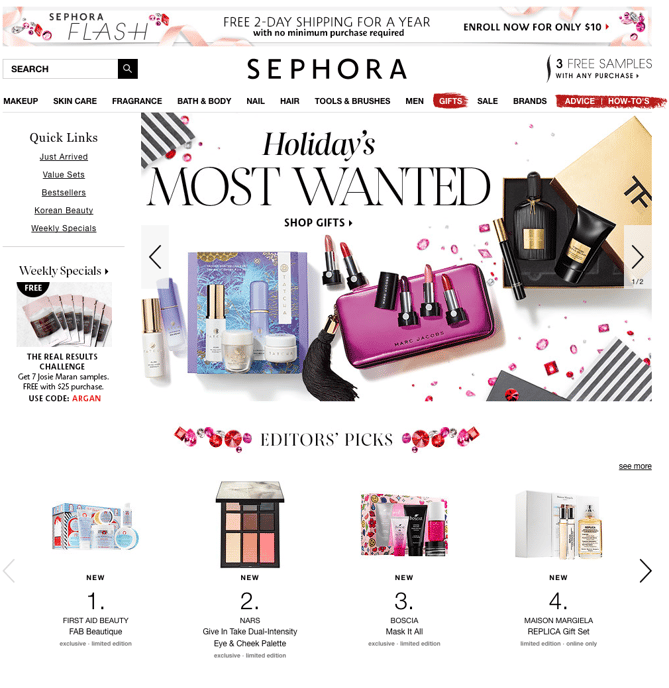
Like PayPal, Sephora didn't make many changes to the overall look and feel of its website. What it did do was feature a holiday edition of its highest-rated products and editors' picks, specially curated for different gift recipients, price ranges, categories, and so on.

By putting editors' picks front and center, Sephora is reminding customers how much the company values customers' success. Plus, we love the sprinklings of gemstones throughout the page -- it's a cute, festive way to separate modules on the page.
Sephora holiday homepage.png

4) Baudville

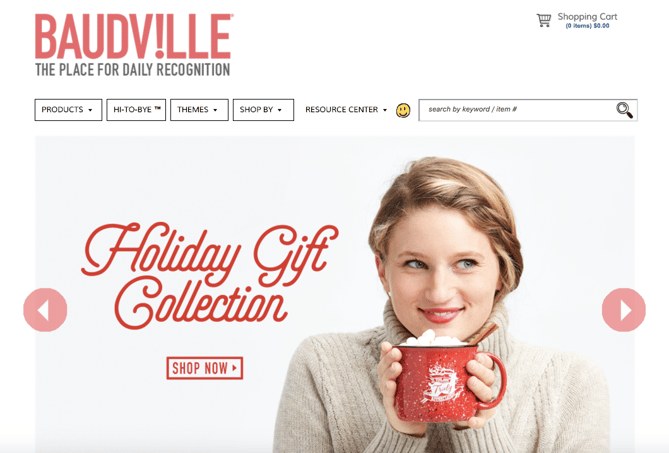
While seasonal website redesign is often dominated by B2C companies, a few B2B businesses have been known to dress up websites a bit too. Baudville, an employee recognition solution, is one.

While some web designers like to add a ton of new elements to their holiday designs, Baudville shows you don't have to. Something as simple as adding a holiday gift shop slide to your homepage photo banner can be enough to warmly welcome users to your site during this time of year.
baudville_holiday.png

5) La Colombe

La Colombe's holiday homepage design features soft, wintry hues and festive lighting. Visitors are greeted with high-definition photography of people enjoying La Colombe coffee products around a shared table. This webpage is another example of a business staying true-to-brand with an added holiday touch.

La Colombe _ Holiday.png

6) L.L. Bean

For a U.S. outdoor retail company like L.L. Bean, the holidays mean winter ... which means cold. (For most of us, unfortunately.) It keeps the holidays out of the seasonal redesign completely: The featured photo on the homepage is a model wearing apparel in front of pine trees covered in show, which is in keeping with the brand's outdoorsy theme.

L.L. Bean shares a list of holiday gift ideas featuring some of its most popular and beloved products. The seasonal homepage slogan -- "Gifts That Last Beyond the Present" -- reminds visitors of L.L. Bean's amazing satisfaction guarantee.

If you're more attracted to a winter-themed seasonal redesign, consider using winter-themed stock photos for your homepage. You might also consider cooling down the color scheme of your whole site for the holiday season. This means using cooler tones like blues, purples, and greens to give it a more "wintry" feel. (You can read more about cool color schemes in this blog post about color theory.)

llbean holiday.png

7) The Container Store

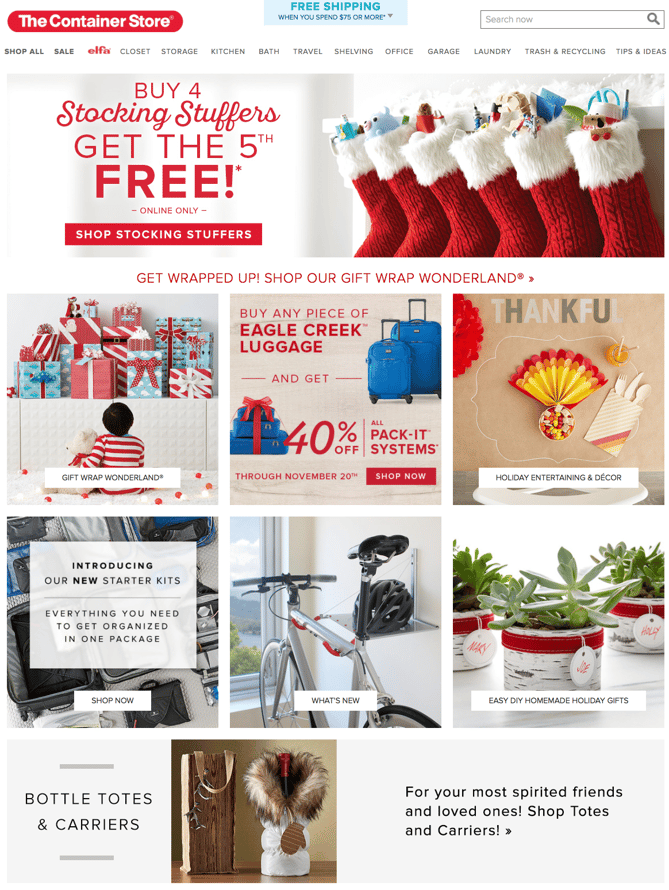
This homepage is a fantastic move for the holidays because it is chock-full of goodies for visitors. Every module on this homepage has something helpful to offer customers -- stocking stuffers, gift ideas, luggage for holiday travel, party favors, and DIY projects.

The various CTAs on the homepage are clear and tell visitors everything they need to know about what's on the rest of the site. The geometric shapes organize all of the content cleanly, so despite the fact that the homepage has several different offers on it, it's not cluttered.
Container Store_holiday.png

8) Xfinity

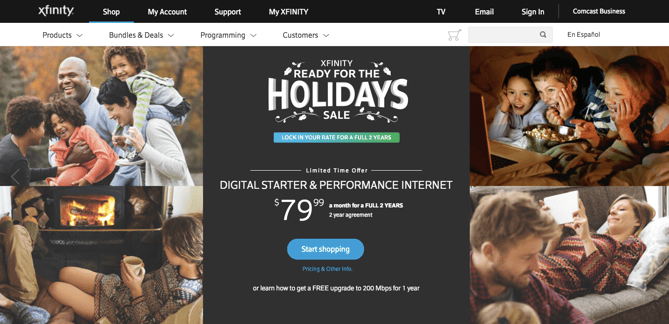
Between sporting events, holiday movies, and making your family binge-watch your new favorite TV series, with holidays comes lots of screen time. This homepage reminds visitors to be prepared for fun with their families.

The primary CTA isn't just "Deals to save you money!" or "Deals to get you to buy from our website!" Instead, this homepage advertises its "Ready for the Holidays Sale" alongside images of families having fun spending time together, some with screens.

Thanks to this positioning, the message feels less like a way to make money, and more like an nod to holiday family time that includes a lot of togetherness, and probably some TV in between.
xfinity holiday.png

9) J. Crew

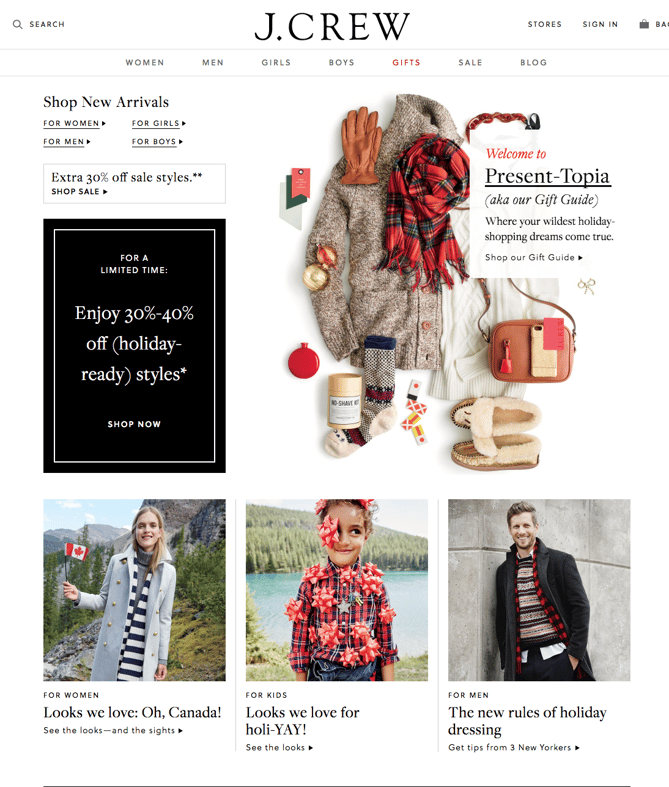
J. Crew's holiday homepage goes above and beyond expectations for a clothing store. The whitespace on the page is simple and lets the clothing and accessories stand out on the page to prospective shoppers while keeping the website true to brand.

Its homepage advertises "Present-Topia," a Gift Guide that breaks down J. Crew products by age, gender, and price for ease of shopping. The black callout box advertises a sale it's running that includes seasonal clothing. J. Crew also published curated looks that visitors can browse or directly shop from to make the shopping experience easier and more visual. This homepage redesign prioritizes the user experience while still keeping the site beautiful and on-brand.
jcrew holiday.png

10) Microsoft

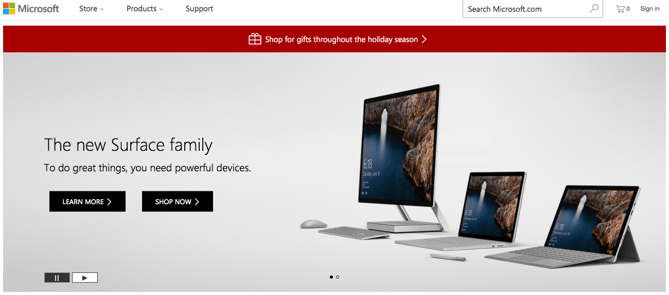
We like Microsoft's minimalist holiday homepage because it stays true to brand and uses whitespace to showcase the new products it's promoting this season. The simple red banner draws attention to their holiday shopping CTA and reminds people to think about products their friends and families might want. Then, there's another CTA reading "Shop Now" that drives home the need to click around and start shopping.
microsoft holiday.png

11) Fitbit

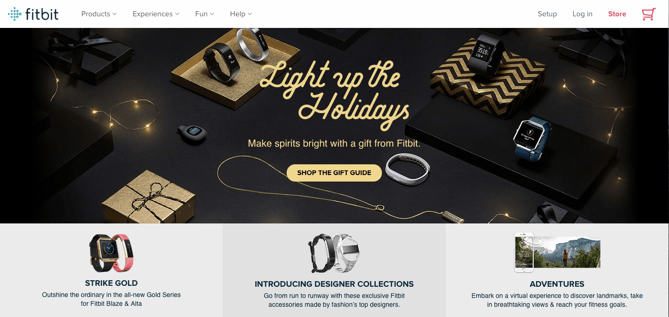
The dark background of Fitbit's homepage lets the festive gold color scheme and the products shine. The photography styling positions Fitbits as a gift similar to jewelry in beautiful boxes, rather than a piece of sporting equipment, to make Fitbit products appeal to a wider variety of shoppers and not just athletes.
fitbit holiday final.png

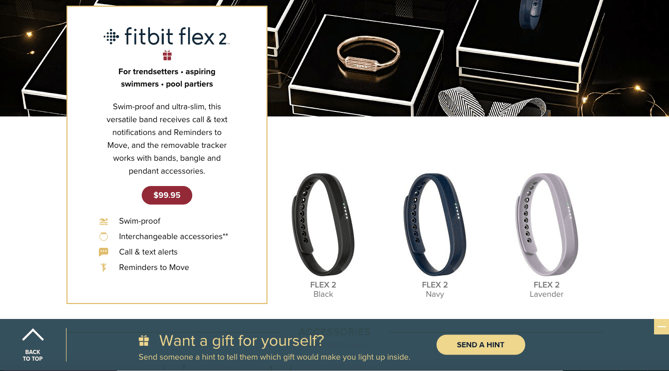
The primary CTA is to "Shop The Gift Guide," which leads visitors through all of the products with descriptions that suggest who they might purchase it for, making it easy for shoppers to imagine their family and friends using the product.

Additionally, the site has a neat feature where visitors can hint to someone that they themselves want to get a Fitbit as a gift.
fitbit gift guide.png

12) John Lewis

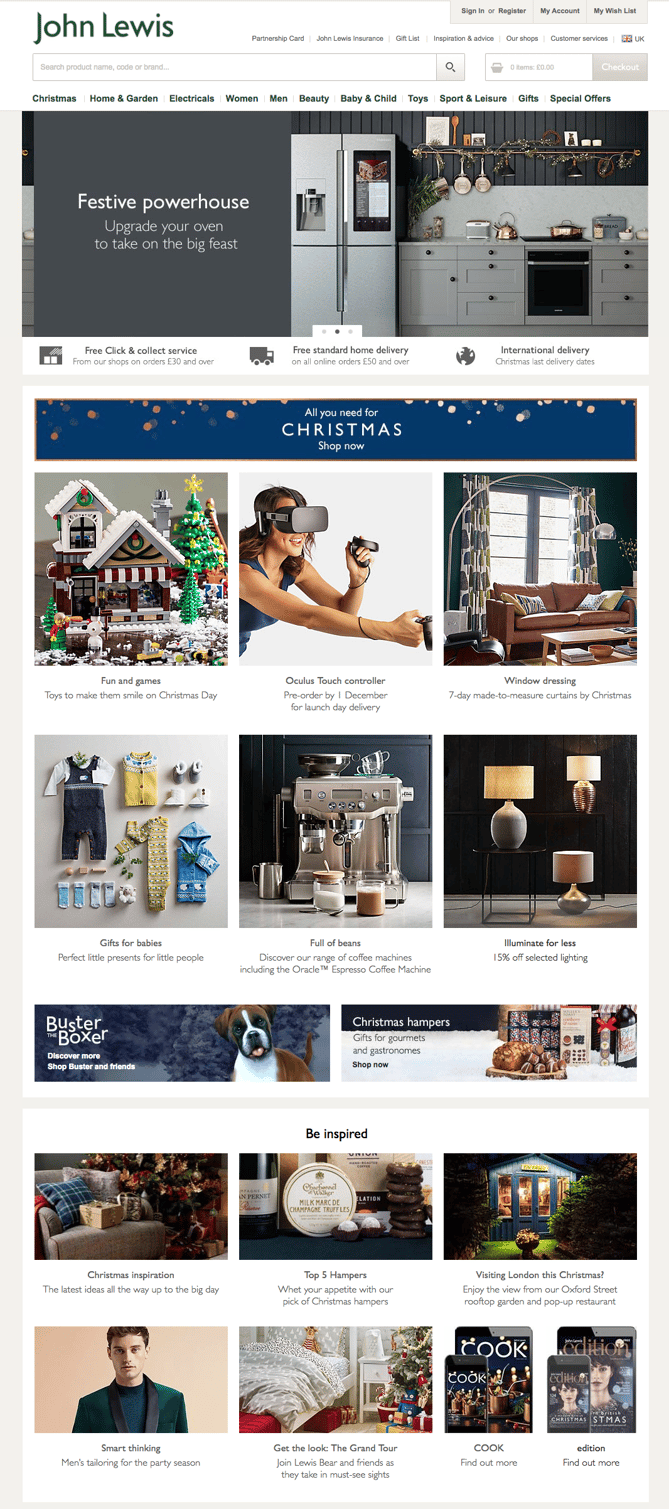
British retailer John Lewis didn't give its homepage a holiday makeover, but by tailoring each module to the season, it makes it hard for site visitors to navigate away before looking at the brand's products and projects ideas.

The main module above the fold features festive holiday decorations with a suggestion to look into the kitchen and home goods to prepare for big family meals. Just below, John Lewis features helpful information about delivery dates for ordering holiday gifts and the bonus that it offers free shipping.

We also love the "Be Inspired" section featuring travel and style ideas that don't advertise John Lewis products outright but instead, provide helpful content in the true inbound marketing way.
johnlewisholiday.png

13) HP

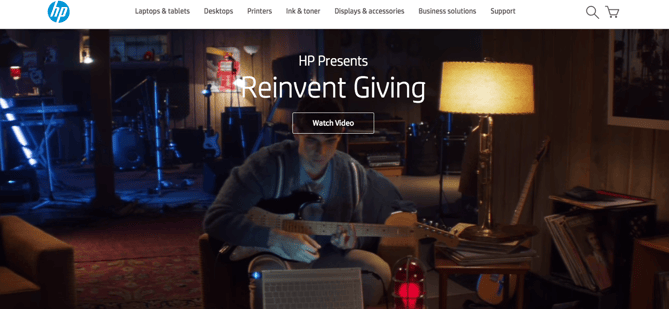
We can't guarantee that HP's holiday homepage video won't make you cry, but we can say that it's a unique and heartfelt spin on traditional holiday marketing. HP's homepage is another example of a site keeping the page minimally decorated with only their featured video, "Reinvent Giving," above the fold.

The touching video features a brother using HP technology to come up with the perfect gift for his brother, who is hard of hearing -- a guitar set that displays flashing lights when played so his brother can see himself playing music, even if he can't hear it. Emotion in advertising is effective, especially around the holiday season -- everyone has a friend or family member they want to find the perfect gift for.
hp holiday.png

14) Madewell

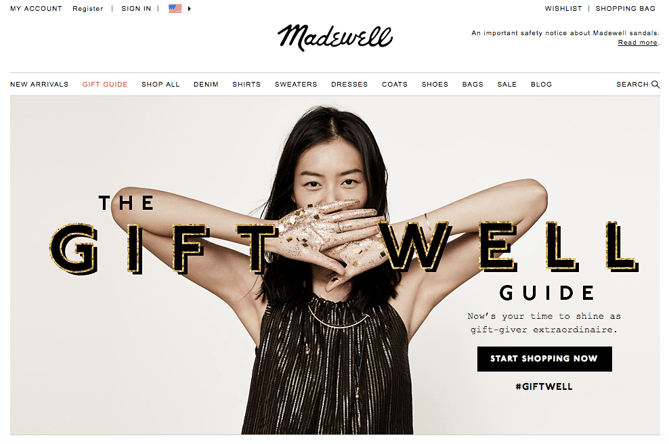
The image and header on Madewell's homepage are very much in line with the company's typical branding: a model wearing a gorgeous dress in front of a neutral background, accompanied by a holiday spin on their name in festive, embellished font.

This is both attractive to first-time visitors who are greeted with simple imagery and user experience, as well as returning users, who expect a design like this but still appreciate the added holiday touches. The #giftwell hashtag prompts visitors to start a conversation about their shopping experiences on social media, which fosters a sense of brand loyalty.
Madewell_Holiday.png

15) Warby Parker

Warby Parker stuck to the basics of beautifully simple design in its seasonal homepage redesign. "Winter 2016" is the simple headline, which showcases a man dressed in winter apparel, set with a whole lot of negative space to draw attention to the details of his outfit -- and namely, his glasses.

While the primary CTA is still its usual "Shop Now," you'll notice a secondary CTA as you scroll that introduces "We Like It, We Love It: Warby Parker Editions." This social proof compels visitors to click, leading them to a curated list of fun holiday gift ideas, such as dog toys and books, including one the brand published called "50 Ways to Lose Your Glasses." This section is unique because Warby Parker is selling items different from what it usually sells to help valued customers fulfill their holiday shopping lists, which is a neat way to foster brand loyalty.

warbyholidayhomepagefinal.png

Finally, Warby Parker's responsive design gives mobile users a pleasant holiday shopping experience. According to Google, 53% of people who shopped online in 2014 used smartphones or tablets, and mobile searches about products while shoppers are still in the store have increased 30%.

The numbers are expected to rise this year, especially now that more people are searching Google on their smartphones than on desktop, so be sure your website is mobile-friendly in time for the holidays.

warbyparker-1.png

(To see more examples of ways ecommerce businesses have redesigned their websites for the holidays, check out this library of examples on Crayon.co.)

Oh, and one more thing: As you plan your own website design strategy for the holidays, be sure to plan and prepare your site for higher-than-normal traffic. The last thing you want is for your site to go down during a time when you hope to be doing great business.

What great homepage redesigns have you see this holiday season? Share with us in the comments.

Editor's Note: This post was originally published in November 2015 and has been updated for freshness, accuracy, and comprehensiveness.

Visit the holiday resource hub for all your holiday marketing needs.


from HubSpot Marketing Blog https://blog.hubspot.com/marketing/holiday-homepage-design-examples

Mapping a #GivingTuesday Follow-up Plan

givingtuefollowup.jpeg

Giving Tuesday is one of the biggest donation days of the year. Once it's over, don't let its impact fade away. Sure, you've seen a boost in donations off your Giving Tuesday campaign, but you've also gotten so much more value you can use to advance your organization's mission.

Once the Giving Tuesday campaign itself is over, have a follow-up plan that keeps the value growing throughout the next year. Here are four pieces to a successful post-Giving Tuesday plan.

1) Run An Engagement Campaign For People Who Donated On Giving Tuesday

Donating is a strong expression of interest. Run a targeted campaign for the Giving Tuesday donors to get them further engaged with your organization. This is not a campaign asking for more money. Too soon.

A Giving Tuesday donor campaign can start with a special thank you for making the day so special. Share some details about what was achieved that day: how much was donated, where that money is going and whom it will help.

Create some image or emoji-laden social content that announces what a rock star they are for having given to your organization on Giving Tuesday. Then encourage them to share the pre-fabbed social content via their own social media profiles. Instead of "I voted" stickers we get on election day, these are the "I donated…" or "I gave to…" social media updates.

If you have events or volunteer opportunities, you might center your campaign around getting them involved in them. Frame it as not just an opportunity for them to be involved, but for your organization to be able to meet its great donors in person and thank them personally.

2) Build Content About How The Donations Will Be Used, Showing Maximum Impact

Some of this content can be used in your Giving Tuesday donor campaign, as well as other targeted campaigns or general social media content.

Start with an eye-catching infographic that shares interesting tidbits about what you raised on Giving Tuesday and how that translates to the good your nonprofit does. Does your program run a program providing after-school tutoring to students in need? How many more students and tutoring hours will the donations support? Let people see what the money will do.

Will the money be used for building improvements or at a physical location? Take a video and give a tour of where and how the money will create more or enhanced resources for the community. As the improvements get made, post update videos they can share too.

3) Plan How To Re-Engage This Year's Donors For Other Giving Occasions

Just because you're not asking your Giving Tuesday donors for another donation right now, doesn't mean you won't in the future. You'd be silly not to prep them for a future ask. 

When you think about a donation campaign for this group, it might be worthwhile to segment them further. For example, new donors and repeat donors, by amount of donation, whether they engaged with your engagement campaign, or got involved in other ways with your organization since their Giving Tuesday donation. It makes sense that these different groups would get different messaging.

What you know they all have in common is that they're motivated by group action and social media events. You might think about building a donation campaign around another meaningful event or even otherwise ordinary social media meme (#WednesdayWisdom, anyone?). An animal rescue group might build something around National Puppy Day (it's coming up in March). There's day for everything. Find one that's relevant to your group.

If you have an annual event that attracts higher dollar donors, put together a prep email campaign for the Giving Tuesday donors that were on the high end. The email campaign can start with content from previous years' events and build up to the save the date and ask. 

4) Report On Your Giving Tuesday Results So You Know Which Marketing Efforts Worked Best

Run. Analyze. Refine. That's the mantra for every marketing campaign and it's no different for Giving Tuesday. Hopefully, you set some campaign goals and identified important metrics pre-campaign. Regardless of outcome, look at each piece of content and point of outreach to see how well it performed. Or who it performed well with and who it didn't.

What devices did most of your converted traffic come from? Which social media channels were most responsive? Did videos perform better than blog posts? How did the conversion rates on different Giving Tuesday emails vary? 

What can you learn about the new donors each campaign tactic attracted? What are the common demographic or psychographic denominators you can find? 

Do a post-mortem that ends with actionable takeaways you can implement right now and to execute an even better Giving Tuesday campaign next year.

You Don't Have To Wait 'Til Next Year

We're not just talking to you Cubs fans out there. Giving Tuesday might just be an annual campaign, but you can incorporate it into marketing campaigns all year long. From content you can build around its impact on your mission to leveraging the new donor data gathered – Giving Tuesday is truly a gift that keeps on giving.

Blogging for Nonprofits


from HubSpot Marketing Blog https://blog.hubspot.com/marketing/mapping-a-givingtuesday-follow-up-plan

5 Reasons Why HTTPS Should Be Enabled on Your Website

https on your website.png

If you’re anything like me, there’s been a time in your life when you’ve asked, “What the heck is https?”

What’s that extra “s” for? Well, it turns out that the “s” stands for “SSL,” which stands for Secure Sockets Layer -- the technology that encrypts your connection to a website, so that hackers can't intercept any of your data.

The whole concept of https is a pretty interesting topic on its own, and my colleague, Jeffrey Vocell, talks more about it here. But in addition to what it actually means, why is it so important? And why do you need it on your website? Download our free introductory guide to A/B testing here. <http://offers.hubspot.com/an-introduction-to-ab-testing> 

Well, there are many reasons, but with the help of my aforementioned colleague, we identified five of the more important ones. (Spoiler alert: A lot of them have to do with your search performance, so have a good look at what they mean for you.)

HubSpot Marketing customers: SSL is included free of charge with the Website Add-On, and the number of domains on which you can enable SSL depends on your subscription type. Learn more here.

5 Reasons Why HTTPS Should Be Enabled on Your Website

1) It’s good for search.

Every minute -- no, second -- Google’s algorithm requires sites to essentially battle it for top search rankings. I love that visual: two websites that could both rank for a user’s query, essentially running toward the finish line of top results. But what happens if there’s a tie? Do the sites battle it out in a “sudden death” round?

Kind of -- there is a tiebreaker involved, and it’s https. The way Google’s Webmaster Trends Analyst Gary Illyes explains it, “If all quality signals are equal for two results, then the one that is on HTTPS would get … or may get … the extra boost that is needed to trump the other result.”

It all goes back to the idea that Google is constantly solving for the user, and makes frequent changes to its algorithm that create a better experience. Which is why our next point makes sense.

2) It’s better for users.

I couldn’t tell you the last time I heard about a hacking incident in which thousands of records were stolen -- because they seem to happen so frequently. In fact, such data breaches jumped 29.5% between 2014 and 2015.

But SSL helps to prevent these “man-in-the-middle” attacks -- “a form of eavesdropping where communication between two users is monitored and modified by an unauthorized party” -- and keeps user information secure.

That makes https especially important if your website accepts credit cards or has a login functionality. With so many of these hacking incidents making headlines, users want to know that your brand is making an effort to protect them from their private information being stolen or compromised.

We could also get into a debate about the ethics of protecting your users from that kind of privacy breach, but you get the point:

  • user privacy = important
  • https = good for privacy

3) SSL is required for AMP.

A few pieces of vocabulary to break down here:

“AMP” stands for Accelerated Mobile Pages. It’s the technology that makes certain pages load almost instantaneously on mobile. So, when you search for something on your mobile device through Google, you might notice that some results have a lightning bolt icon next to it, that means that it’s AMP-ready.

Look at what happens when I search for Doomtree, my favorite hip hop group, on my phone. On the first page of results, one has the lightning bolt icon next to it. And when I click on that result:

... it loads instantaneously.

AMP is going to play a major role in SEO in the coming months -- Google is making it a priority for 2017, which implies that AMP-ready pages will have better rankings. But in order for something to be labeled as AMP, it requires SSL.

We’ve covered the importance of optimizing for mobile quite a bit, and preparing for the special attention that will be paid to AMP is now part of that optimization. But in order for webmasters to be as web-friendly as possible, all of the requirements behind AMP must be closely examined -- including its https criteria.

4) Google is indexing mobile.

So, that thing we just said about the importance of mobile? It turns out, Google is actually going to start indexing mobile, which means that its “algorithms will eventually primarily use the mobile version of a site’s content to rank pages from that site.”

But in order for a mobile site to be indexable, Google recommends several best practices, one of which is to “start by migrating to a secure site,” especially “if [you] don’t support HTTPS yet.”

And bottom line, says HubSpot SEO Senior Marketing Manager Victor Pan, “HTTPS is preferred over HTTP in the index, with all other things being equal.” So get secure -- you’ll be glad you did.

5) “Not secure.”

To elaborate -- In January 2017, Chrome 56 will start displaying “not secure” in the browser bar for any http (notice it’s missing the “s”) sites that ask users for login or credit card information.

I don’t know about you, but when I’m about to make an online purchase and see that the site isn’t secure -- for example, that the padlock icon in the browser bar is broken -- I navigate my business elsewhere. And I’m not alone. In fact, only 3% of online shoppers say they would enter their credit card information on a site without the green padlock.

Imagine if Google starts doing that work for users before they can even get to checkout. If the number is as low as 3% now, before search engines start doing the legwork to label sites as “not secure” before anyone even visits them, you can see how traffic to those sites will suffer a huge blow -- as well as its digital sales revenue.

Create a Safe Space

There you have it. If you want your SEO to stay strong -- on both desktop and mobile -- and you don’t want to lose digital sales revenue, it’s easy to see why https should be enabled on your website.

These are just a few reasons why https is so important. What are yours? Let us know in the comments.

> Learn about all the product launches from INBOUND 2016

from HubSpot Marketing Blog https://blog.hubspot.com/marketing/enable-https-on-your-website

How to Fix Your Agency's Low Morale Problem

As an agency leader, do you have a plan for what you’d do if 30-50% of your employees quit?

You might be at risk right now, according to the latest Campaign US survey on agency employee morale.

To summarize from this recent HubSpot article on the growing agency morale problem:

  • Nearly half of all agency employees report having "low" or "dangerously low" morale in 2016 -- up from one-third in 2015.
  • Roughly 30% of agency employees are actively looking for new jobs. (I venture that even more would leave if approached with a strong opportunity.)
  • The top three causes of low morale were company leadership (73%), lack of advancement (45%), and dissatisfaction with work (38%).

Now that we know there’s a problem, how do we solve it? Subscribe to HubSpot's Agency newsletter today.

The good news is that the top causes of low morale are primarily within your control -- so you can fix them at your agency.

How to Fix Your Agency's Low Morale Problem

1) Assess your own management and leadership skills.

As Manager Tools notes: "The definition of an Effective Manager is to achieve results while retaining your team members."

Be honest with yourself -- are you getting results and retaining your team? If you’re seeing only one of those (or neither), you probably have gaps as a leader and manager.

According to Glassdoor, a former agency owner spent most of his time at the race track instead of leading his agency. That’s not a good message for employee morale.

You may need to get perspective from someone outside your agency -- we often lack perspective on ourselves. You can reach out to a business partner, your romantic partner, a business coach, or a "frenemy" at another agency. But you have to make it safe for them to share honest feedback, or else you’re defeating the purpose.

Be aware that their perspective may hurt at first. In my first 360 review as a manager, current and past colleagues said I was good at getting things done… but not at making it fun for everyone else. That wasn’t fun to hear, but taking it to heart meant I could start improving.

2) Hire people to fill in your gaps as a leader.

Improving your weaknesses only goes so far. I believe managers should focus on maximizing their strengths, and then recruit others to balance out their weaknesses.

If you're great at sales and big-picture thinking, but you struggle with operations, you'll probably never become great at operations. And you’re also unlikely to enjoy operations anyway. Instead, hire a great operations person -- someone who excels at the things you don't enjoy.

If you're great at operations but struggle at people-related nuances, get help. At the very least, seek out insights from someone with better people skills before you roll-out an agency-wide initiative that might make people unhappy.

Reflect for a moment: What are your gaps as an agency leader? How might you ask current and future team members to help you fill those gaps?

3) Help your middle managers upgrade their management skills.

When I speak with front-line employees at agencies, I see a pattern of problems around middle management. Often, the executive leadership team is good at managing people -- but the middle managers aren't always as competent.

Part of the issue is usually the agency's fault. If you promote people who aren't ready to manage others, it's not surprising that your new managers will struggle. Give your middle managers the tools they need to succeed, and be ready to coach them on coaching their employees.

Don't assume they know what you’ve learned over the years. I share 31 tips for managers in my book Made to Lead, but knowing is only the beginning -- people still need to practice management every day.

Find ways to observe your middle managers as they manage. Management is a "learn by doing" profession. You want to provide spot feedback (privately) to help people improve while situations are fresh.

4) Show employees how they fit into your agency's future.

When I do anonymous Employee Culture Surveys at agencies, I often get feedback that employees feel confident about their agency's future… but they're unclear how they fit into that future.

Alleviating employee stress around the future depends on your agency’s headcount and your growth plans. When an agency has 10 people, there’s not much room for promotions -- everyone’s doing a bit of everything, and it doesn’t make sense to have a large layer of middle managers. In contrast, a 50-person agency typically has plenty of room for employee advancement.

If you’re currently small and likely will be for the immediate future, be honest about your plans. Some people will choose to leave, but you can turn it into a controlled departure instead of a sudden departure.

If you’re growing, map out the future org chart and team structure. Identify where you’re going, and what the transition roles might look like. Then, speak with employees about the agency’s future, along with each person’s individual professional goals.

5) Commit to improving work/life balance.

Work/life balance was the key factor among high-morale employees in the Campaign US survey. Improving work/life balance won’t fix morale if you’re also a terrible manager, but it’s the next place to look once you’ve started to improve yourself.

How many hours are your employees working? According to my research on agency workloads via Inbound.org, most agency people are working less than 50 hours a week. A significant minority (23%) are working more than 60 hours a week, but that’s not the norm.

Apart from occasional spikes, long workweeks may be a sign that you’re understaffed, that people aren’t billing enough, or that you’re doing a bad job at project management.

Work/life balance is about flexibility, too. Are you focused on results… or expecting butts-in-seats facetime? The workweek can feel longer when employees feel unnecessarily chained to their desk.

6) Send (and act on) employee satisfaction surveys.

If you don’t know how your team is doing, it’s harder to improve. Keep in mind that perception is reality -- employee morale is about what employees think and feel, not what you think and feel as an agency leader.

Because I want my team to be happy, I regularly check-in to ask how things are going by sending a "satisfaction check-in." I ask team members the following five questions to find out how happy they are with their work, and what I can do better as a leader.

  1. What's working?
  2. What's not working?
  3. What should I do differently?
  4. Do you see any opportunities or gaps in the business that I am (or might be) missing?
  5. Anything else you'd like to share?

Based on their answers, I can improve my leadership and management, as well as improve the business overall.

You can conduct simple employee surveys yourself, or you can use an employee engagement tool.

7) Invest in professional development.

Spending cash and time on professional development pays off in two ways. First, it helps employees improve their skills -- which means they’re better at helping your agency’s clients. Second, it shows employees you’re investing in their future -- whether they stay or go.

The right budget and time allocation will depend on your agency’s lifecycle. But regardless of the amount, I typically see a strong payoff for agencies.

Don’t forget to include management and leadership coaching. Once you equip your team with more skills and experience, it also makes it easier to promote from within -- which helps solve the "lack of advancement" morale problem.

8) Conduct (and act on) exit interviews.

Your best efforts won’t keep everyone -- and that's okay. It’s normal to have at least some employee turnover. (You might expect 10-25% annual employee turnover, depending on the size of your agency.)

When someone says they’re leaving, don’t try to convince them to stay -- they’ve already made up their mind. But you can use their experience to prevent other good team members from leaving.

Use exit interviews to find what you're doing wrong, and fix whatever the problem is as well as you can.

It’s important that you act on what you learn. If you tend to take things personally, you should delegate the exit interview process to another member of your leadership team.

Applying These Tactics at Your Agency

If you’ve observed an employee morale problem -- or suspect one is festering -- you can solve it.

To do this, you need to identify the underlying cause(s) and then take action. The solutions are often free or inexpensive, but they require you to commit to improving as a leader and a manager.

Don’t underestimate the time it will take to fix things -- some changes can happen immediately, but others can take months of consistent action, especially when it involves regaining employees’ trust.

Leadership development can feel painful at first, but it pays off with better employee retention and results. Ultimately, you’ll enjoy work more -- and you can see a higher payday if you ultimately choose to sell your agency.

What will you change first at your agency to boost employee morale? Let us know in the comments.

creative-brief-cta


from HubSpot Marketing Blog https://blog.hubspot.com/marketing/how-to-fix-your-agencys-low-morale-problem