Monday, 30 January 2017

Fact or Fiction: The SEO Edition [Quiz]

Picture1.jpg

Just when you thought you were up-to-date on the latest SEO best practices, an algorithm change or a new expert post has you questioning yourself. Sound familiar?

It's true, the world of SEO is spinning faster than ever, and for every new strategy, an old one becomes obsolete. As inbound marketers, it's our job to stay informed of these changes, while continuously questioning the status quo.

Today, successful inbound marketers turn their attention to a long overdue focus on high-quality content. Marketers and SEO agencies worldwide have halted their obsession with link building and keywords and re-prioritized for this specifically. Stop wasting time on SEO strategies that don't work with the help of this free PDF guide >>

Is your team still focusing on keywords rather than topic clusters? How about meta descriptions - how has Google been treating them differently as of late? See how you and your team fare in the new world of search engine optimization by taking this 10-question quiz.

Fact or Fiction: The SEO Edition

How'd you do? What questions do you still have? Share them with us in the comments below.

seo myths 2017  


from HubSpot Marketing Blog https://blog.hubspot.com/marketing/fact-fiction-seo-quiz

10 of the Best Ads from January: Slo-Mo Dogs, Falling Pianos, and an Epic BBQ

If your New Year's resolution is to take a more creative approach to advertising, then we've got some inspiration to get your 2017 started off right.

While many of us were still adjusting to a normal work schedule again after the holidays, these agencies were producing some of January's most captivating, hilarious, and admirable work.

This month's roundup includes standout spots from around the globe, including a particularly existential clothing commercial from the Middle East, and an anti-smoking PSA from the Netherlands that takes on big tobacco with a unique spin. We've also included the viral, student-produced spec ad that AdWeek called the "most moving work we've seen so far in 2017."

Check out our recap of January's best ads below, and get inspired to tackle your own big projects in 2017.

10 of the Best Ads from January

1) Meat & Livestock Australia

What brings people together better than ... lamb meat? That's the premise of this extended spot for Meat & Livestock Australia, which assembles an ambitiously diverse cast of lamb-lovers for one epic beach side barbecue.

Produced by Sydney-based agency The Monkeys, the entertaining ad features Indigenous athletes Cathy Freeman and Greg Inglis, transgender comedian Jordan Raskopoulos, and several boatfuls of colonizers from Europe and Asia -- all of whom are super into grilled lamb, apparently.

The inclusive tone seems like an attempt to make up for the company's ill-received Australia Day ad, which was one of Australia's most complained about ads of 2016 for its perceived lack of sensitivity to Indigenous people and vegetarians. 

2) Film Academy of Baden-Württemberg (Spec Ad for Adidas)

Get the tissues ready for this one. Students at Germany's Film Academy of Baden-Württemberg created this poignant and visually stunning spec ad for Adidas, and it went viral on YouTube seemingly overnight. The short film follows an elderly protagonist as he attempts to escape his convalescent home for the simple pleasures of an outdoor run. 

Writer/director Eugen Merher, who created the piece as his second-year project at the Film Academy, told AdWeek the inspiration came from a late relative: "An old man with a very young spirit who used to walk two kilometers every day and bring his wife flowers."

3) Centrepoint

This ad's answer to existential dread? Looking great.

Impact BBDO Dubai created this ad for Middle Eastern clothing retailer Centerpoint, and it somehow manages to make life's potentially fatal uncertainties seem oddly quirky.  You can't control a fiery piano falling towards you, but you can control what you wear while it happens.

4) No7

If anyone knows a thing or two about defying expectations for their age, it's ballerina Alessandra Ferri, who appears in No7's latest campaign for an anti-aging serum. The now 53 year-old Italian dancer was the youngest prima ballerina at London's Royal Ballet when she was 19, and continues to dance professionally today.

In the ad, which was produced by Mother London, Ferri is shown dancing alongside a ghostly vision of her 19 year-old self. It's a truly mesmerizing concept that's especially unique for a skincare ad.

5) Expedia

Promoting a message of global fellowship, this ad for Expedia follows a woman through a lifetime of purposeful travel. From the time she looks over her neighbor's fence as a child to see the world beyond her own backyard, she's compelled to immerse herself in new cultures and experiences.

Clocking in at just one minute, the 180LA-produced spot packs in a surprising amount of narrative. "We believe that the more each of us travel and peek over our neighbor's fence, we learn that we have more in common than we have different," said Vic Walla, senior director of brand marketing at Expedia, to Adweek.

6) Duracell

Wieden+Kennedy developed a new delightfully offbeat campaign for Duracell, focusing on some of the little (potentially unexpected) ways consumers can trust the brand's batteries on a daily basis.

"We're taking a lighthearted look at the real issue of trust," said Ramon Velutini, Duracell's vp of marketing. "Because while you do need trustworthy power when you're climbing K2 -- the world's second-highest mountain -- you also need it for your game controller and your kids' toys."

7) Stivoro

What if employees at a tobacco company party were completely honest about their industry?

Stivoro, the Netherlands' Foundation for Smoking and Health, teamed up with Wefilm to shed some light on the dangers of smoking (and the hypocrisy of the tobacco industry) in this darkly comic new PSA. 

8) Planet Fitness

Being judged sucks. Being judged by a CPR dummy you're attempting to give mouth-to-mouth? Well, that really sucks.

In their ongoing campaign to position their gyms as no-judgment zones, Planet Fitness worked with agency Hill Holliday to develop this wonderfully hammy ad for the New Years' resolution crowd.

9) New York Lottery

It's a common icebreaker question: What would you do if you won the lottery?

If you're like the guy in this ad for the New York Lottery, your answer involves dogs. A lot of dogs.

To promote their Cash4Life game, the state-run lottery teamed up with McCann New York to highlight one of the nonmaterial benefits of winning: having more free time to volunteer. It's a simple spot with an uplifting message -- featuring some hilarious slow-motion closeups of running dogs.

10) Angel Soft

I never thought I'd be tearing up at a toilet paper ad, but this one for Angel Soft from Deutsch is surprisingly heartwarming.

The ad chronicles a single dad raising a daughter on his own, and it does a great job capturing some the little, commonly overlooked moments of growing up -- all framed in the context of toilet paper, of course.

social-networks-ads


from HubSpot Marketing Blog https://blog.hubspot.com/marketing/best-ads-january

Friday, 27 January 2017

Do Your Tweets Deliver Revenue? Here’s How to Use Kissmetrics to Find Out

The average social media manager gets paid roughly $47,190.

They tweet, post, share, like, favorite, comment, and reply to make sure your company’s social media is covered.

Some companies use social media differently. Slack, for instance, uses Twitter to communicate the brand and notify followers on product updates. Here at Kissmetrics, we’re tweeting links to our content. Expedia tweets sales offers to the hottest (pun intended) destinations.

So with all this tweeting and sharing, does any of it really convert to revenue? Granted, some companies couldn’t care less if the tweets to their product announcements lead to signups. But some companies are invested heavily in social, with managers and interns making sure their bases are covered. But for those that are promoting their deals 10x a day (I’m looking at you, JCPenney) is it worth it? Do those tweets convert to revenue?

Here’s how to use Kissmetrics to find out.

Tracking Links Back to Revenue

UTM tagging makes a marketers job infinitely easier. Any campaign you’re promoting, just tag the URL with some UTM parameters and watch the traffic come in.

You can apply these UTMs to the links you share on social as well, even if you’re using a link shortener like bit.ly. They’ll simply redirect to the URL containing the UTMs.

So let’s say we’re a marketer for a small e-commerce company. We have a moderate Facebook and Twitter following, combining for about 25k fans. We regularly tweet out sales and other promos to our followers.

But there’s a gap – we don’t know if anyone actually purchases after clicking the links.

Enter the solution: Kissmetrics. With Kissmetrics, we’ll track who is clicking these links and if any of them actually convert to purchasing.

So if we have this link, tagged properly with UTMs to promote our upcoming sale:

https://www.example.com/?utm_source=social&utm_campaign=January_sale&utm_medium=twitter&utm_content=twitter

Then we’ll share it on our Twitter page. We can make the same link for our Facebook followers, just switch the Campaign Medium and Campaign Content from twitter to facebook.

Now comes the fun stuff – tracking it to see if anyone is converting!

We’ll load the Kissmetrics People Report and set it find the people who did these two steps in order – viewed the url listed above, and then converted.

people-search-find-people-who-did

So we have a couple things here – we’re telling Kissmetrics to find the people who have viewed the URL https://www.example.com/?utm_source=social&utm_campaign=January_sale&utm_medium=twitter&utm_content=twitter and then purchased. Our date range is set for the last 7 days.

We can do anything else to replace Purchased. Maybe added item to cart, signed up for newsletter, viewed product video, etc. But for now, we’ll keep it as Purchased.

And because we’re tracking revenue with Kissmetrics, we’ll create another column to see the total purchase amount each customer made:

people-search-add-columns

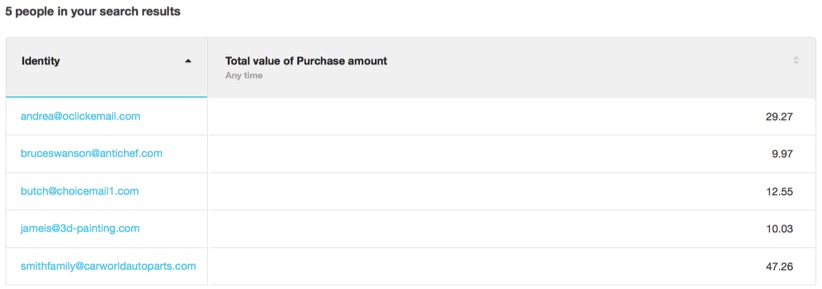
We’ll run the report and get our list of people and their revenue:

people-search-total-value-purchase-amount

This shows us that 5 people made purchases from that link we shared on Twitter. We also see each customer’s purchase amounts, ranging from $9.97 to $47.26.

Tracking Social Media Campaigns

Some of you may have social media campaigns. You may be using a hashtag for your campaigns, and want to track all the links coming in from the campaign. For this, you can use UTMs and keep the same Campaign Medium.

For example, if you’re promoting your winter campaign on Twitter and have hundreds of links pointing back to your site, you can change all the UTM parameters but keep the Campaign Medium the same. This will make it much easier to track.

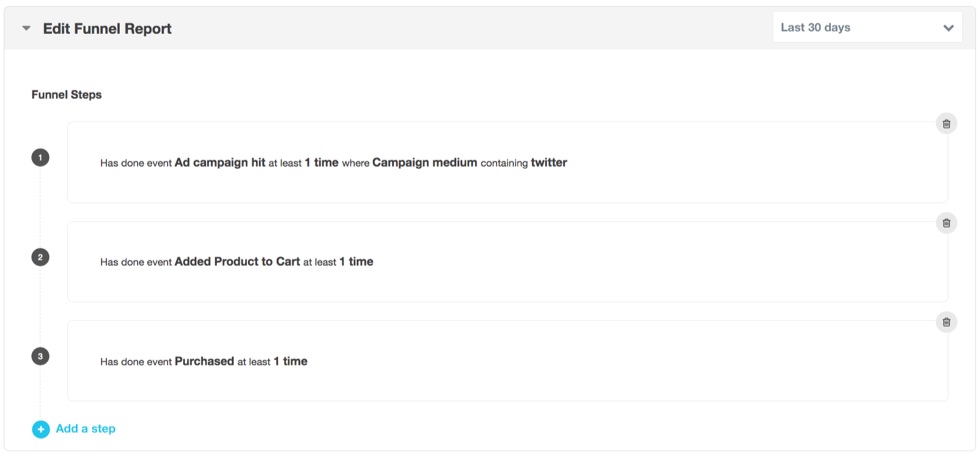
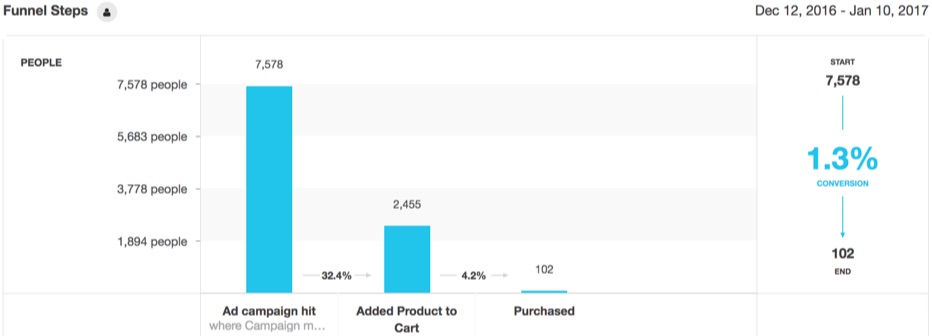
Let’s see how this plays out in a Funnel Report. Here’s how our setup looks, step-by-step:

  1. We’re looking for people who came to our site via a UTM with the campaign medium being twitter. Anyone who came to our site without that campaign medium will not be included in this funnel.
  2. These people will have to add a product to the shopping cart to be included in step 2.
  3. And they’ll need to make a purchase.

funnel-report-steps-ad-campign-hit

Let’s run the report and get the data:

funnel-report-ad-campaign-hit

We see that in the 30 day span, we had about 7500 people visit us from this campaign medium, of which 102 people ended up purchasing. From here we can judge the campaigns performance to see if the cost and effort was worth the returns.

Conclusion

What’s the return on your social media?

For many companies, it’s been almost impossible to quantify. Most social media tools cannot tell you your return. But with Kissmetrics, where you can tie revenue to campaigns, you’ll see the returns you’re getting for every tweet, hashtag, and influencer mention.

Questions? Put them in the comments.

About the Author: Zach Bulygo (Twitter) is the Blog Manager for Kissmetrics.


from The Kissmetrics Marketing Blog https://blog.kissmetrics.com/tweets-to-revenue/

Welcome to Marketing In The Engagement Economy

engagement-economy

Author: Steve Lucas

You’ve heard it a thousand times: digital transformation has shifted the way companies do business. As a part of this shift, buyer expectations have changed. As a marketer, there are dozens of ways to reach your customer, but the trick is finding out how, when, and why they want to be engaged. Now, a thoughtful, personal, seamless, experience is what customers crave.

The Engagement Economy

That is the idea behind the “Engagement Economy”—a digital future where everyone and everything is connected. It embodies the fundamental shift in the relationships between buyers and sellers, but extends across an entire organization to include customers, prospects, employees, and partners. What’s important for you to know is that if your company does not embrace and adopt transformation in the Engagement Economy, it won’t be long for this world.

Companies that don’t transform risk being outpaced by new, digitally native brands who are able to give customers the experiences they crave. Think of Blockbuster Video. They had a huge brand presence, with over 10,000 physical locations in the U.S. alone, but when Netflix came on the scene, Blockbuster couldn’t adapt to the new model of renting videotapes, DVDs, and music. In 24 months, Blockbuster was gone. Why? Because Netflix offered the customer an experience they actually wanted! And, that’s just one example of a digital native organization. Think of some of today’s most talked-about brands: AirBnB, Uber, etc. We love them because of the experience they provide us, yet neither of them own any real estate or cars.

But not every company is a digital native. In fact, most aren’t. If you’re like the majority of companies out there, you are racing to implement a digital infrastructure that enables you to listen to, learn from, and engage with your customers. So how do you do it?

Drive Wantedness

Success in the Engagement Economy hinges on, well, engagement. Imagine that! Digital transformation, is not about processes, technology, or even sales and marketing—it’s about transforming your organization at its core to create experiences that feel real and human and are founded on trust and care.

In the Engagement Economy, it is all about building personalized, authentic relationships with your customers and driving the idea of wantedness. Wantedness is a really compelling concept based on research by Wunderman, and it’s the degree to which a brand proves their commitment to earning a customers’ business across every touchpoint—across the entire customer journey. In a me-centric world, where consumers expect us, the marketer, to

understand and communicate to them when they want, how they want, on the right channel, and at exactly the right moment. Being wanted is essentially the result of driving an authentic buyer experience.

Digital Transformation with Impact

So where do you go when you’re faced with the need, or maybe paranoid fear, to digitally transform your organization to drive wantedness and participate fully in the Engagement Economy?

You find a partner to lead you through the intense, vast, and complex tangle of data and point systems. Not only are market pressures great—from customers and your competition, but so is the internal pressure from leadership, like your CEO. The partner to help you drive an impactful transformation in your organization is a platform that is built from the ground up—one that is, at its core, built to orchestrate end-to-end marketing engagement.

The Marketo Engagement Platform enables marketers to listen to, learn from, and engage with their customers at scale. And scale is critical when you look at how a strong infrastructure can support and surround your customer to drive wantedness. With the scale, reliability and openness of the Marketo Engagement Platform, marketers are able to partner with integrated solutions to deliver orchestrated experiences.

Looking for a few examples of how partners and customers are thinking about the Engagement Economy? Check out this video:

The Engagement Economy is here. Your partner is here. Now is the time to transform your organization and your marketing to drive success and win the hearts and minds of your customers.


Welcome to Marketing In The Engagement Economy was posted at Marketo Marketing Blog - Best Practices and Thought Leadership. | http://blog.marketo.com

The post Welcome to Marketing In The Engagement Economy appeared first on Marketo Marketing Blog - Best Practices and Thought Leadership.


from Marketo Marketing Blog http://blog.marketo.com/2017/01/welcome-to-marketing-in-the-engagement-economy.html

The Goldfish Conundrum: How to Create Content for Short Attention Spans

distracted_content_creation_compressed.jpg

The creation of mobile devices has made multitasking close to ubiquitous in the modern world. Between social media, live streaming, and digital news, it’s hard to imagine a time of day when we aren’t tempted to look at a screen while we’re doing something else at the same time.

Because of this phenomenon, it should come to no surprise that the average human attention span has fallen to just eight seconds -- shorter than that of a goldfish.

What’s more, 59% of people share articles on Twitter without even reading them, and more than half of all pageviews are under a minute in length. It’s clear that people aren’t reading as much as they used to, and content creators need to adapt their strategy to that reality.

In this post, we’ll discuss strategies and resources marketers can use to create content that will generate clicks, shares, and most importantly, more readers.

The Current State of Content Marketing

Back in September, Content Marketing Institute (CMI) and MarketingProfs released their annual B2B content marketing survey results, revealing that 70% of respondents plan to produce more content in 2017 than in 2016. However, while content production continues to rise year over year, content engagement saw a 17% drop in 2016, according to TrackMaven.

This dip could be a reflection of decreased content quality, as proper planning and research tend to fall by the wayside when marketers ramp up their output. But it could also be attributed to that attention span shrinkage we mentioned earlier. After all, today's readers are more likely to skim blogs, long-form written content, and podcasts rather than thoroughly consume them, according to data from HubSpot Research.

What's a marketer to do? Let's dive into our strategies for defying the goldfish attention span, without sacrificing the quality of your content.

How to Create Content That Gets Consumed

You already know that content creation is an integral part of the inbound marketing methodology. It attracts visitors to your blog, cultivates brand awareness, and helps you generate leads for your organization. But what about page views? Here are our strategies for making sure you’re not just creating into the void, but are actually producing content that gets consumed and shared.

Write quality content

We know, this one seems like a no brainer. But with 30% of marketers reporting that they don't have clarity around what content marketing success looks like, it's an important issue to stress.

It’s estimated that bad writing costs businesses close to $400 billion per year in inefficiency and productivity loss. And it could also be costing your organization if you’re generating content that isn’t driving any results. So before you start putting fingers to keyboard, implement a few processes to make sure you’re writing quality content that’s also useful to your audience.

Here are a few ideas:

One of the easiest ways to create content that your audience will read? Ask your audience what they want to read about. Conduct social media polls and surveys to find out what topics and content types your subscribers are interested in, and brainstorm ideas based on their feedback.

For example, The Muse publishes content for job seekers about career growth, and they ran a poll asking their Twitter followers what would improve their workday.

Sure enough, shortly after the poll closed on Twitter, they published this article based on the results:

twitter_poll_title

Clever, right? Experiment with social media polls and ask for engagement from your followers. Encourage your audience to engage with the poll to generate content ideas and more participation on social media, and see what ideas you come up with based on the results.

Invest in thought leadership

When setting your blog editorial calendar for the months ahead, ask yourself: Are there any topics that someone in the organization, such as a founder or executive, is uniquely qualified to write about?

That’s thought leadership -- and it's not as difficult to incorporate into your strategy as you might think it is. In fact, there are a lot of small steps you can take to incorporate more thought leadership into your current editorial.

Here are a few ideas:

At HubSpot, we frequently partner with influential organizations -- like Trello -- to create content that reflects our combined expertise. By collaborating with the folks behind Trello to put together a comprehensive guide for using the project management tool in your marketing campaigns, we demonstrated our ability to provide credible, helpful tips -- straight from the source:

Hubspot_trello_comarketing

Brainstorm other organizations in your industry and determine a mutually beneficial way you could collaborate. Whether that’s guest posting, cross-promotion, or working together as in the example above, keep bringing new ideas to the table that your audience can’t help but read.

Create visual content

Your audience wants to see more visual content, and it performs better, too: readers spend more time looking at images than words on a web page, and images promote greater memory recall than text alone.

There are a variety of different types of visual content that you can create to draw attention and promote greater readership, and our blog has a number of step-by-step guides to creating eye-catching infographics, videos, and more.

Vox does a great job of providing written and visual content for its readers. On any given day, it might publish a data visualization, a long-form article, and a video featuring different angles on the same topic -- in this case, the Women’s March on Washington -- to match different people’s content preferences and to keep things fresh for its audience.

Data Visualization

Womans March Data Viz.png

Long-Form Article

Vox Long Form Article.png

Video

Vox Womens March Video.png

The lesson? Don’t automatically default to writing a blog post simply because it’s a medium you’re comfortable with. Experiment with creating visual content to tell data-driven stories your audience will click, and hopefully share, too.

Meet the reader halfway

Follow the Golden Rule: Treat your reader as you’d like to be treated. Most of us are busy people, and busy people on the internet like to skim-read content. Luckily, you can make it easier for readers to consume your content all the way through with different formatting, layout, and coding choices.

Here are a few ideas:

  • Use headers and bolded text to break up sections and paragraphs so readers can maintain focus.
  • Use bullet points and numbered lists to draw the eye to a new format and pay closer attention. (See what we did there?)
  • Include summary and takeaway sections in your written content to help readers remember what they’ve been reading about and maintain their interest.

Even better, help the reader understand how quickly they’ll be able to read a piece before they get started. Check out how Medium does this in an example from ThinkGrowth.org, HubSpot’s Medium publication:

medium_skimming_example

(For more examples of publications that produce easily consumable content, try reading this blog post for inspiration.)

Publish on a variety of channels

Another challenge to getting people to thoroughly consume your content is they just may not have found it yet, and that’s where off-site content can come in handy. Audiences vary across different platforms, and it’s easier for your content to get discovered, and then read, if it’s published in more places than just your blog.

Medium is one example of where you can publish different content to attract a broader audience. You could create original content for a Medium publication, or repurpose old content by turning text into an infographic or video. As HubSpot Vice President of Marketing Meghan Keaney Anderson notes:

On the open web, people are searching, but on Medium, people come to spend time reading. This leads to much higher engagement on Medium and it’s this engagement, not search behavior, that fuels further discovery.”

Social media platforms also offer a variety of features for publishing original content. For example, you can publish live video on Facebook, ephemeral messages on Snapchat, photos on Instagram, and blog posts on LinkedIn. To ensure you're publishing on these channels at the most optimal time, check out this guide from ClearVoice on when to publish content on social media for different industries.

Getting Started

We know this is a lot of information, but competition is getting stiff, so experimenting with how you create content now will pay off in the future. If you need help getting started, here’s our list of free tools to make awesome content.

What’s your favorite type of content to read? Share with us in the comments below.

free content creation templates


from HubSpot Marketing Blog https://blog.hubspot.com/marketing/content-creation-short-attention-spans

When Is a Phone Call Better Than an Email? 6 Times When You Should Take It Offline

phone-call-vs-email-compressor.jpg

I don't know about you, but as a rule, I communicate better via written word.

It gives me time to think. It lets me use the vocabulary that my SAT tutor hammered into my brain so many years ago. And most of all, it gives me a screen to hide behind when I have to confront an uncomfortable topic -- making the situation much less awkward. But there are times when even I, the perpetual wordsmith, have to make an actual phone call.

Speaking to another human being over the phone can be nerve wracking. Maybe it's because so few of us actually use our mobile devices for that anymore -- after all, Pew Research found that text messaging is the most widely-used feature on them.  Reap the positive ROI benefits of email marketing with the help of this 14-point checklist for optimizing your emails. 

But even if it looks like phone calls are fading on the surface, there are times when they're still essential -- especially, it seems, where a sensitive subject is concerned. That means it's time to stop hiding behind the screen, take a deep breath, and dial. We've outlined six of the most important occasions when a phone call is better than an email. Have a look, and start talking.

6 Times a Phone Call Is Better Than an Email

1) When You Want to Apologize

Most of us grow up understanding that, when we do something wrong, we should say, “Sorry” -- 96% of parents think it’s important for kids to apologize when they deliberately upset someone, and 88% believe the same is true, even when it's unintentional. But what constitutes a heartfelt apology?

It’s so hard to admit when we’re wrong. And to actually say it out loud -- “I’m sorry” -- is even more challenging when we have the option of quickly typing it out in an email or text message. That’s why it can carry so much more weight when someone actually calls us to apologize. Assuming he or she means it, we can hear the person’s remorse.

But if you’re afraid of screwing up an apology when you try to do it off-script, you can still write it down before you make the call. That can help to give you an idea of what it is that you really want to say, and can mitigate the risk of stumbling your way through saying sorry. Just make sure it sounds natural -- an apology won’t seem very authentic if it sounds like you’re reading from a script.

2) When You Anticipate a Lot of Questions

My colleague, Leslie Ye, recently had a phone call with someone to discuss a project for the HubSpot Sales Blog. She specifically chose to have a spoken conversation -- rather than explain the parameters over email -- for a few reasons. Among them, she told me, was that she anticipated the writer would have several questions.

As it turns out, she was right. “Calls that have a lot of questions are typically harder to handle over email, because that’s not a real-time conversation,” Ye explained. “With a phone call you, can go back and forth on one question until it's clarified, then move on to the next one.”

In other words, it was more efficient for Ye and her counterpart to address all questions in a single phone call, rather than over a string of emails. When you do the latter, you risk losing track of what’s been asked and answered. But there’s a catch -- if you don’t take notes during your call, it’s just as easy to forget what you’ve discussed, given our declining attention span and retention of details.

For that reason, there are times when it’s a good idea to combine a phone call with an email. Following up in writing is a helpful way to ensure that both parties are on the same page after a conversation, and gives you a point of reference after the fact.

3) When You Have to Explain Something Complicated

There’s a reason why telephone support still exists. We use it here to help HubSpot customers, and for good reason -- 73% of customer service managers say that support inquiries are becoming more complex.

Written instructions are always helpful as a point of reference -- see above. But if you’re trying to follow a series of complicated steps, or you’re simply new to what you’re doing, it’s tremendously helpful to have someone walk you through it via spoken word.

As a channel consultant, my colleague Adrianne Ober deals with this phenomenon daily. “Email is great for getting to the point and keeping on task,” she says, but “a conversation is going to naturally provide deeper context.”

But while it’s great to be friendly, it’s also crucial to stay focused -- it can be easy for the conversation to go off-track, Ober says, especially when you strike a good rapport with the person you’re speaking with. So remind yourself of the purpose behind the conversation, and stick to it until the issue is resolved.

4) When You've Taken Way Too Long to Respond

It’s tough to say how many unread emails exist in the average person’s inbox. When I polled by team, just over 37% of my colleagues responded that they have anywhere between 11 to over 50.

Screen Shot 2017-01-06 at 12.07.08 PM.png

That explains why it’s so easy for emails to be overlooked or forgotten. Admit it -- how many times have you opened an email and marked it as “unread” with intention of answering it later? That habit makes it easy for messages to quickly become buried under constant incoming email.

There are two potential solutions to this issue:

  1. Organize your inbox with resources like HubSpot Sales, or any number of the email management tools we’ve listed here.
  2. If you’ve overlooked something crucial, call the sender.

Remember our advice to call when you need to apologize? Here’s a great example of when that’s particularly helpful. With inbox overload becoming a workplace epidemic, chances are, the person you’re calling will understand a little bit of neglect. Plus, making the effort to actually call the person and address the issue -- rather than responding with an overdue email that’s just going to flood his or her inbox, too -- speaks volumes. It sends the message that the person is a priority, rather than something at the bottom of endless to-do list.

5) When You Need to Discuss Something Personal

Simply put -- life happens, and sometimes, it’s not so awesome. And on occasion, the less-than-awesome things require us to temporarily step away from certain responsibilities, like work.

As we’ve emphasized, using the spoken word in lieu of email can help to make your counterpart feel like a priority, and to understand the significance of what you’re discussing. So when you need to bring up something personal, like a family emergency or medical issue, skip the email and have a real conversation about it instead.

That also helps to instill a sense of empathy. Not too long ago, researchers at the University of Michigan found that there was a 40% decrease in empathy among certain populations, which correlated with an increased use of technology. It’s a symptom of hiding behind a screen -- and, therefore, not being able to associate emotion with what’s being said.

That’s why we generally advise using the phone -- or an in-person conversation, if possible -- when you need to discuss anything important, as we note below.

6) When It's Really Important

What constitutes “urgent,” these days, has become somewhat fluid. We’re a deadline-oriented culture -- in fact, it’s been found that adding a deadline to a task makes us 24% more likely to do even get it done. But sometimes, we can’t pull off those deadlines alone. We need to interview an expert for a quote, or have an official party sign off on something.

But remember -- a lot of us have unread emails in the double digits. So when an important request comes in, even when labeled as “urgent,” it’s easy for it to get pushed down by a high rate of incoming emails. What’s urgent to me, might not be a priority for the person I’m trying to reach.

Sure, “most Americans would rather type it than say it,” writes Chicago Tribune’s Corilyn Shropshire. But reaching out by phone not only prevents an email from going unread -- and adding to the recipient’s email avalanche -- but also, it helps to instill that sense of empathy we mentioned before, and emphasize urgency.

Here’s another instance when following up in writing can help. If you can’t reach the person at his or her desk, for example, email might be received quicker, since 88% of us check it on our smartphones. Try sending a written summary of what you said in your voicemail, but save the meaty details for a phone call, so that they don’t get lost in the email shuffle, as per Ye’s above example. But be respectful of that person’s time, and ask when it would be more convenient to speak by phone -- that whole “empathy” thing goes both ways.

Make the Call

To be clear, we’re not trying to knock email. We love email -- there are times when it’s an invaluable resource for marketers, and when it’s a perfectly appropriate method of communication.

But we also like to keep a human element to things, which is why -- and feel free to call us “sentimental” -- sometimes, we like to talk it out. These are six instances in which that’s the way to go, and when it can help you accomplish things more effectively.

When do you opt for phone calls over emails? Let us know in the comments.

free email copy templates


from HubSpot Marketing Blog https://blog.hubspot.com/marketing/when-phone-is-better-than-email

Thursday, 26 January 2017

How to Evaluate the ROI of Branded Content

In 2011, Google’s Zero Moment of Truth report struck fear into the hearts of marketers and companies alike with its finding that the average consumer reviews 10.4 pieces of content before converting.

What made this finding so scary? It underlined the importance of content to modern marketing strategies, and many companies feared they weren’t producing nearly enough content to drive conversions.

To remain competitive, marketers and small businesses jumped in feet first.

Their version of “shoot first; ask questions later” resulted in a lot of content produced on websites that wasn’t actually doing much converting.

The Benefits of Branded Content

Soon, astute businesses realized that publishing high-quality content instead of high volumes of content was what really counted. These businesses began reaching out to pay to get their content published beyond their own websites, on the sites of complementary online publications — often those with more traffic.

This type of content, called “branded content” (or “sponsored content”), is a way for brands to expose their content to a much larger audience than their own websites, while possibly building a collection of trustworthy backlinks to their site and getting their brand in front of more eyes.

women-inmates-oitnb-nyt

Image Source

An example is this branded article that New York Times’ T Brand Studio produced for Netflix. While this piece doesn’t mention the benefits of Netflix services or products in a traditional advertising sense, it does provide original and thought-provoking insight into the topic of female inmates — a topic that also serves as the main focus of a Netflix original series. Instead of spending their dollars on a banner ad telling consumers to watch Orange is the New Black, Netflix put their resources towards getting an intriguing piece of content in front of the eyes of over 1 million New York Times readers; content that may inspire many of those readers to watch the related Netflix series.

Marketers and advertisers are embracing branded content because branded content pieces have been shown to be more engaging than banner ads. Studies show that the use of ad-blocking software is on the rise, and 45% of AdBlock users expressed a desire to remove as many ads as possible from their web experience. Engagement with branded content is more robust; while viewers spend an average of 1.6 seconds looking at a banner ad, they spend much longer engaging with branded content (anywhere from 60 seconds for branded news content, to 323 seconds for branded finance content).

A 2015 study from Business Insider’s BI Intelligence estimates that marketing spend for branded content (called “sponsored” content in the study, and represented in red in the graph below) will continue to rise significantly over the next few years.

native-advertising-revenue

Image Source

Branded Content Strategy Challenges

Measuring the success of these content pieces accurately and clearly in order to assess return on investment (ROI) is one of the biggest challenges that brands and advertisers face when implementing a branded content strategy. Without a solid understanding of ROI, it’s difficult to steer a successful campaign, and even more difficult to get buy-in from executives who control the advertising budget and want to see that their dollars are well spent.

Research from the Content Marketing Institute reveals that 33% of B2B marketers and 41% of B2C marketers cite “the inability to measure (ROI) as a significant challenge” to producing branded content.

As a relatively new avenue of marketing, measuring the ROI of branded content can be a challenge. The good news is that it can be measured; and those who do measure their branded content are more likely to receive buy-in (and budget approval) from executives, and obtain stronger insights to cater their marketing strategy to their target market.

If your senior management team is hesitant with using branded content as an advertising opportunity, having clear metrics to measure success may be what you need to tip the scales. There are five different metrics that you can track to show the ROI of branded content you have produced.

The Metrics to Measure

The metrics to use when determining how content contributes to a company’s bottom line include:

Consumption Metrics

Important because they reveal brand awareness and “reach,” consumption metrics can include:

  • Page views
  • Blog/infographic/video views
  • Downloads
  • Social chatter: Social-listening services like Mention and Radian6 can tally how often your name comes up on social channels, blog posts, and forums.

Consumption data measures brand awareness and web traffic. The key is to measure these metrics before the content rolls out; set a goal for desired increase in each metric, and track these increases after the release of a branded piece.

Lead Generation Metrics

Most brands today offer a free download in exchange for an email address. The addresses that come in are leads. The company can then send the leads helpful blog posts and offers on a regular basis through email marketing campaigns. Each of these leads indicates that your content has impressed or intrigued the reader enough to convert.

Form submissions are also counted as leads. These indicate that your website’s content is compelling enough to get a visitor to ask for a phone call from you.

Track leads generated through either your email management system or a customer relationship management (CRM) system to evaluate your efforts and see where most of your leads are coming from. You should also consider adding a “how did you hear about us?” question to your newsletter sign-up form.

Conversion Rates

The best content gets people to take action. A click from a blog post on your website — and, eventually, a sales page or email sign-up page — indicates the post has pulled its weight.

Google Analytics is one of the best tools to use for conversion tracking for branded content. With accurate tracking, (the Campaign URL Builder is a huge help here) content that funnels significant traffic to popular sales pages can be given proper credit and used to guide efforts in the future.

Sharing Metrics

Social likes, comments, shares, and email forwards all indicate that the reader agrees with or appreciates the information enough to pass it along to friends. They may even view sharing it as a way to increase their own social clout.

Most publications will have buttons or metrics on published branded content to show shares, and there are tools, like Coverage Book or Share Tally, that can be used to track how many people have shared a branded post with their networks.

Sales Metrics

C-suite inhabitants tend to want to go right to the ultimate goal: sales metrics. “How many sales has this content generated?” Unfortunately, in an era where consumers expect to be wooed and educated before buying, sales metrics aren’t the easiest to attribute to content.

It’s common knowledge that prospects require multiple touches before deciding to buy. Content tends to take the role of lead nurturer, providing the multiple touch points required to warm up a prospect.

With Google Analytics and marketing automation working together, however, marketers can see how many web visitors came in from different content pieces. When a web visitor goes from a post to a sales page, marketers should count that action as an “assist.”

Surveys: Content Measurement from a Different Angle

When combined, the five metrics above are powerful tools for assessing your branded content’s ROI — but the monetary measure of a piece of content can still be difficult to fully comprehend. You can build a more robust picture and add context to many of the above metrics through consumer surveys.

With an easily accessible, brief, and well-designed survey, you can gain insight into consumer reactions to your content and your brand’s overall reputation. When paired with metrics like social shares, downloads, or form submissions, you’ll uncover a clearer picture of why and how your content is driving the conversions you see — allowing you to adjust your strategy according to what works and what doesn’t.

Sometimes brands can even get the publisher that hosted their content to conduct a survey for them. Publishers want to demonstrate how the content their clients pay dearly for is swaying and even motivating customers to buy. They must show their results if they expect to get return customers.

In one example, BuzzFeed surveyed two audiences: one that had seen five to nine of its client’s “sponsored” (paid) posts and another that hadn’t. The client, cell carrier Virgin Mobile, worked with BuzzFeed to come up with articles that would appeal to BuzzFeed readers.

buzzfeed-virgin-brand-publisher

After running the articles for a few months, BuzzFeed asked two yes-or-no questions:

“Virgin Mobile is a brand I’d investigate for my next phone purchase.”

and

“Virgin Mobile is a brand that understands me and the things I like.”

buzzfeed-virgin-mobile

Image Source

Recipients that had been exposed to Virgin Mobile’s articles were 150% more likely to report that they’d consider the brand when it came time to purchase another phone. Those that had seen the articles were also three times more likely to conclude that Virgin Mobile was aware of their values and interests. Both answers typically lead to brand lift and better sales. For many companies’ marketing goals, this “lift” can be considered part of the ROI for their branded content.

Is Branded Content the Future?

The era of banner-ad dominance is at an end. Studies show that ad blocking is on the rise, and 60% of clicks on banner ads are accidental. Marketers and advertisers know this; and they recognize that branded content may be a good alternative. Branded content is one way to provide connection to prospects that will make them grateful or amazed, and more engaged with their brand. What most marketers need to achieve now is buy-in on the part of their superiors, and tangible metrics that can guide their strategies to success.

By using these tips to monitor and assess branded content, marketers can take the extra step and measure the traffic, leads, and even the affinity their content drives. The BI Intelligence study mentioned above found that consumers have far more goodwill toward branded content than disruptive advertising. Consumers come to a website or publication looking for useful information or entertainment. When they get what they came for, you’ve got satisfied consumers and built positive relationships with your brand. As a marketer, you’ve always known this is the key to positive ROI — and now you can prove it.

About the Author: Andrew Lovasz is the CEO of Main Path Marketing, a leading digital marketing firm providing enterprise level solutions to SMB and mid-market companies. He has 17 years of experience as an executive in the digital marketing industry, with clients ranging from Verizon Wireless to thousands of small and mid-market car dealers, restaurants and hotels.


from The Kissmetrics Marketing Blog https://blog.kissmetrics.com/roi-of-branded-content/