Tuesday, 5 December 2017

How to Acquire Customers with Facebook’s New Messenger Ads

Facebook recently released Facebook Messenger app ads to the general public.

Aaaaaannnnnddddd digital advertising just got even more creepy than ever imagined.

Thanks, Zuck.

You can now directly message potential prospects via Facebook Messenger right in their inboxes. Kinda like LinkedIn’s Sponsored InMail. Meaning you can nag people 24/7 now.

But with all of these new features comes white noise. Using the right tactic is like finding a needle in a haystack on new platforms.

Just like with any new digital advertising platform, it’s hard to know what works and what doesn’t.

What will help you acquire customers and what will get you reported for stalking.

Here’s how to find that proverbial needle in the haystack by using Facebook Messenger ads to acquire customers.

The Three Main Types of Facebook Messenger Ads

Currently, Facebook offers three main advertising formats or placements with their new Messenger ad services.

Each one is different. But you can use them all together to create one big, happy, harmonious user experience.

Here, we’ll look at each in-depth, analyzing the best practices for each to get the best bang for your buck.

First up: Messenger destination.

1. Messenger Destination Ads

Your first Facebook Messenger ad option is destination-based.

This works like any old display-style ad on Facebook.

It sits right in the news feed for someone to click on.

But instead of taking them directly to the Facebook page or a landing page on a website, it takes them into a conversation on Messenger:
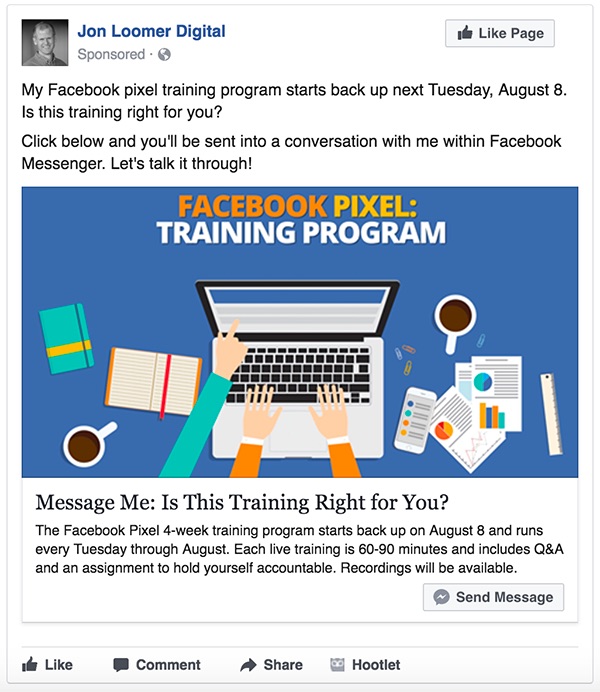
Image Source

Instead of a call to action like “read more,” it says “Send Message.”

It’s a great conversation starter and strays from the normal display ads you see on Facebook.

For example, lead magnets are great, but they often get stale.

We’ve seen the same thing a thousand times over. And eventually, that means results decline, too.

These destination ads, though, can help streamline your customer acquisition process in two big ways:

  1. Qualification: You can initiate a conversation up-front before spending hundreds of dollars to get a user into your funnel. They work to start a conversation on topics that are either complex or expensive. For example, if you’re selling SEO services, these are perfect for initiating a qualification conversation before a full-scale consultation that costs time and money.
  2. Retargeting: Once you have a broad audience for your Messenger destination ads, you can funnel those engaged users into sponsored messages – the third format we’ll touch on today.

Messenger destination ads are best used to start a conversation. To get people interested in learning more about your offer without having to give up personal information or schedule a full-blown call.

(Who even talks on the phone anymore?)

These ads can also serve as a form of account-based marketing. Meaning you focus on qualifying prospects ahead of time rather than trying to get them into your funnel to qualify them at the end.

Account-based marketing seeks to narrow the pool early in order to spend more time on ideal clients.

This produces better clients that are more likely to convert, while trimming away the clients who are just there for a free eBook.

For example, Facebook expert Jon Loomer is already using the destination-based ads to start conversations ahead of time:
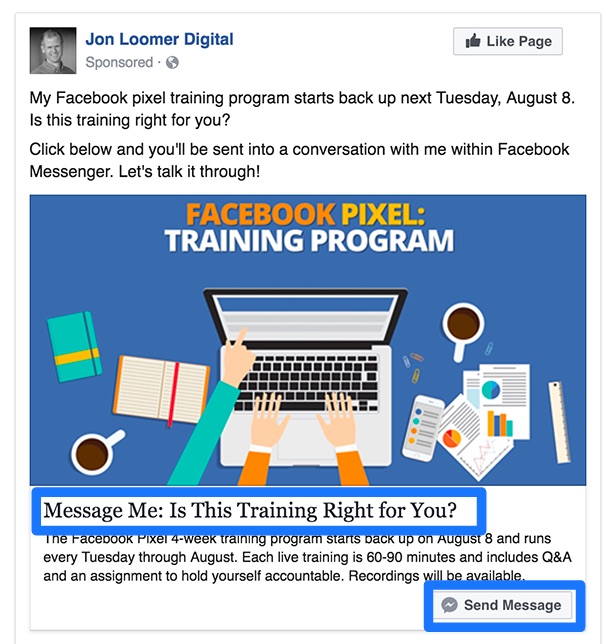
Image Source

Instead of simply offering an eBook and collecting thousands of emails that won’t convert, he takes a direct approach:

Message Me.

Is this training right for you?

He’s effectively qualifying leads before they are even leads.

Now he can narrow down the candidates and skip the traditional funnel process where most won’t convert even at the bottom of the funnel.

DigitalMarketer is using the same strategy to get qualified users to interact with their business (before they’re ready to sign on the dotted line):
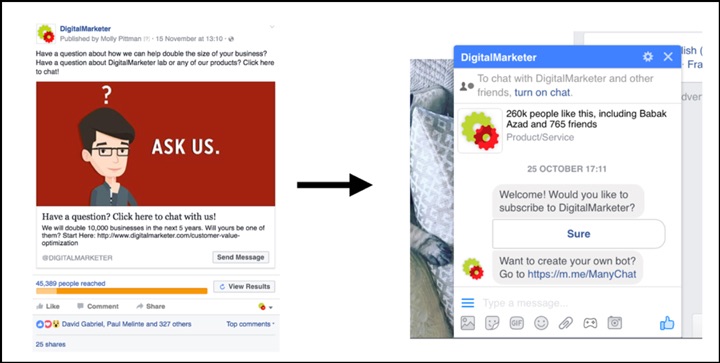
Image Source

Once qualified users click “Send Message,” they are asked about subscribing to the newsletter and are allowed to ask any questions about how the platform can help their business.

These ads work just like a live chat on your site but without the need to drive that site traffic in the first place.

Meaning you can save money and time, all while qualifying prospects up-front.

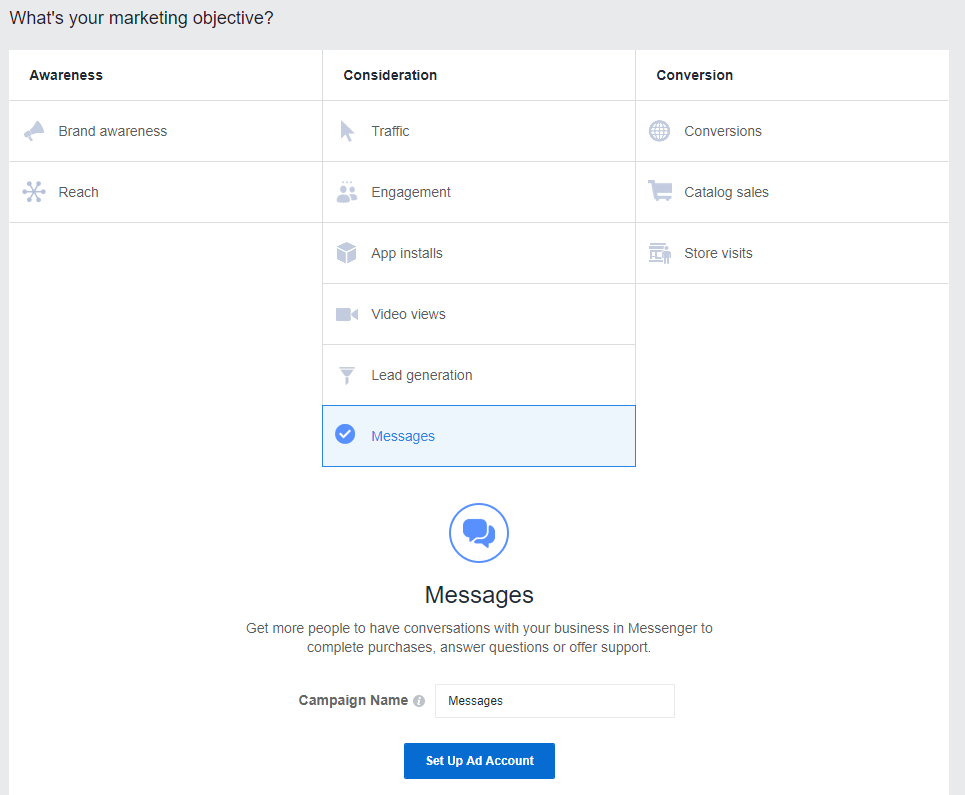
To get started with these ads, head to your Facebook Business Manager and create a new ad based on the messages objective:
Under the messages section, make sure that “Click to Messenger” is selected:
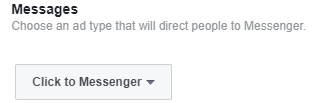
This ad type will show up in the news feed and direct users to a message click, like the examples above.

After selecting your audience, scroll down to the ad format and choose either a video or a single image:
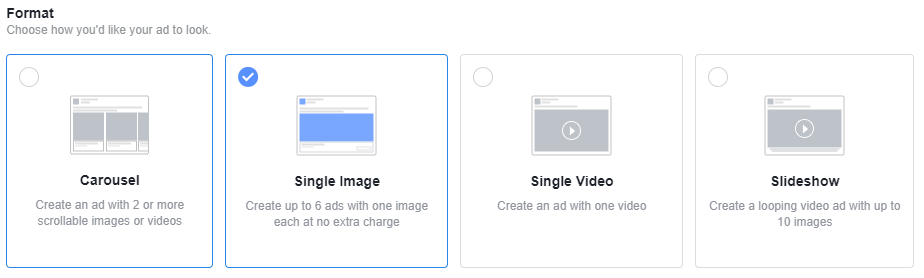
The key here is to get specific.

You don’t want a user to feel overwhelmed with ten options to message you.

Plus, it makes it easier to create a specialized message and offer by using a single image or video.

Next, upload an image or video:
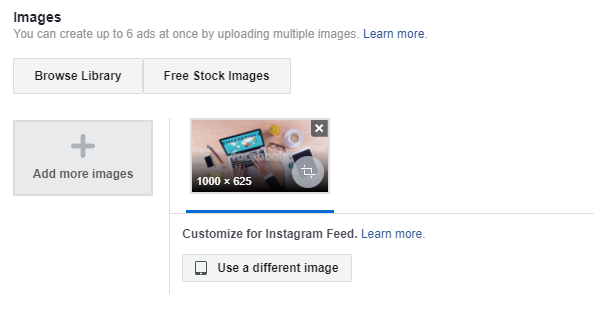
Now comes the fun part. Start setting up your ad with a headline and text:
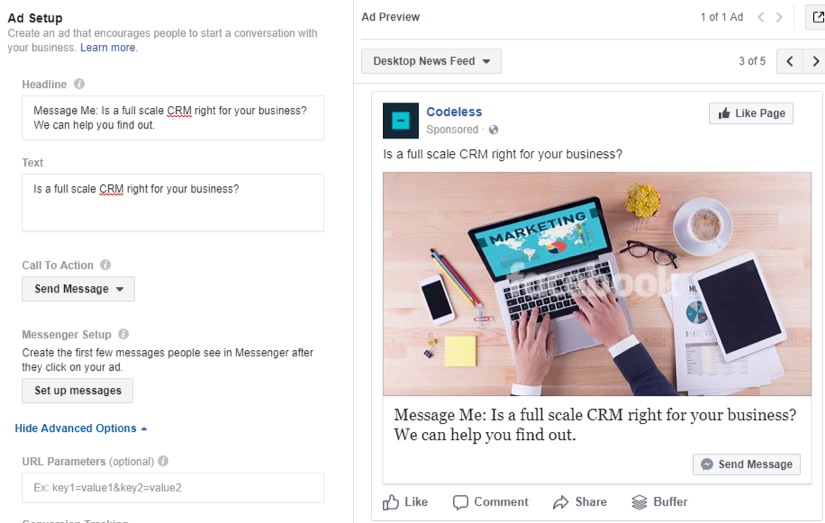
The goal here is to qualify prospects ahead of time and to get information on whether they’re right for your business or not.

You don’t want to appeal to everyone and waste your budget on clicks that don’t convert.

Ask the most burning question that your best customers ask when converting on your product, encouraging them to message you.

Be sure to select “Send Message” as your call to action, too.

This will start a conversation in their messaging inbox.

Now there is only one step left:

Setting up your welcome messages:

This will be the opening message that someone will receive when they click on your ad.

You can now start to customize your message format and even the customer actions available:
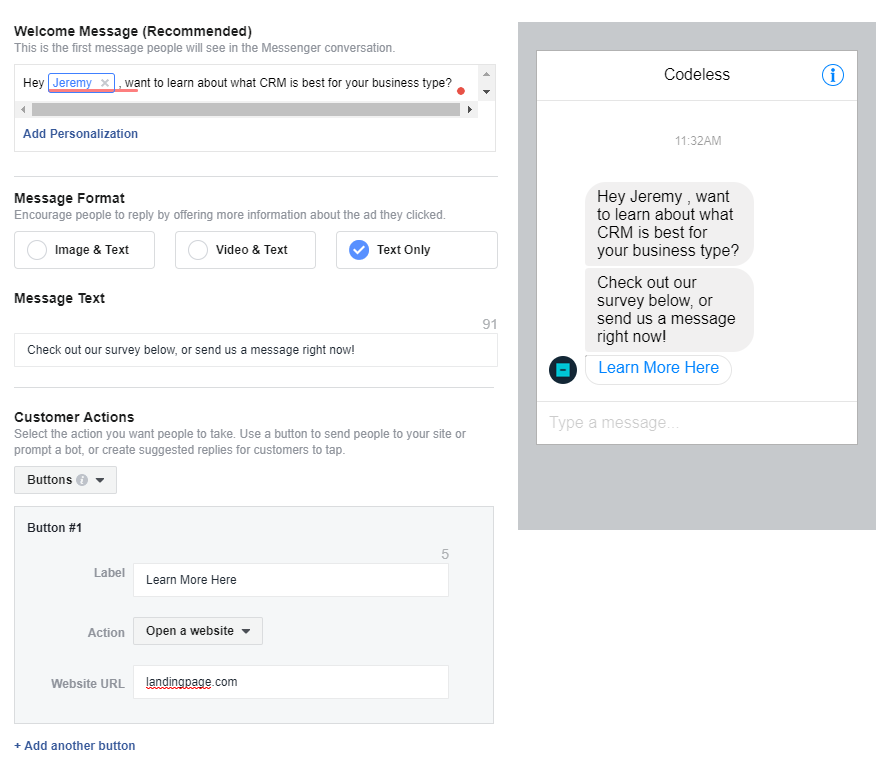
You can also add basic personalization to make each message feel personalized and targeted.

For example, in this ad, we are qualifying users up-front and allowing them to either click to a landing page off of Facebook or message us directly on the Messenger ad.

You can customize these buttons to your liking, driving traffic to your site or landing pages, or simply encouraging more conversation within Messenger.

Remember: Best practices for this ad focus on lead qualification and getting people to start a conversation with your business.

2. Messenger Home Placement

The Messenger home placement is slightly different than the destination-based ads.

This type focuses on sending messaging options directly to the home section of a user’s inbox.

Here’s what it looks like:

Image Source

It works the same way as the Messenger destination ads do in the sense that a user has to initiate the conversation.

Meaning you can’t just message them individually. They have to accept your invitation to message first.

Here’s how Jon Loomer has structured his home placement messaging ads:
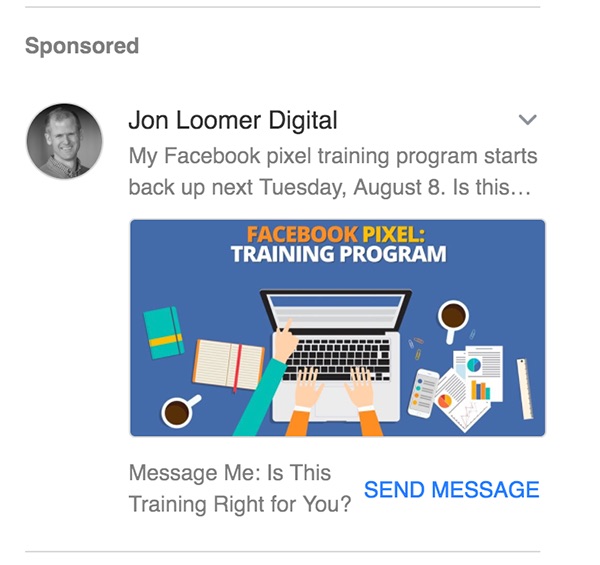
Image Source

They work as a sponsored blast, just like your destination ads. But instead of appearing in the news feed, they show up in the messaging app.

It’s simply another way to get in front of your audience with targeted messages.

The majority of ads should focus on qualifying prospects and getting them interested in your business without asking for information just yet.

Thankfully, this one is extremely easy to set up.

All you have to do is check the “Home” box under the placement section of your ads:
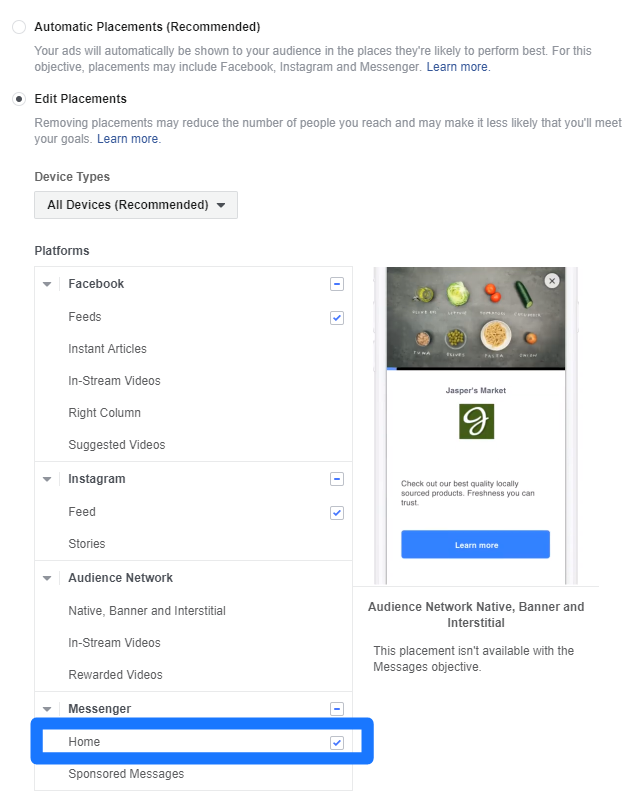
This will allow your ads to show in the Messenger app as well as the newsfeed for a combined approach.

Follow the same strategy here of generating a conversation rather than trying to land prospects with a lead magnet or a quick sale.

3. Sponsored Messages Placement

Sponsored messages are one of the best new additions to advertising options on Facebook.

But you can’t use these sponsored message placements on just any audience.

Which is actually great if you think about it.

Imagine randomly getting a message from a company you’ve never heard of that asks you to buy SEO services or some other random, untargeted offer.

Blocked.

It’s safe to say that an approach like that would kill the user experience on Facebook. People don’t come to Facebook to get bombarded with ads.

They use the search network for that. The intent simply isn’t there.

Using these sponsored messages allows you to send a direct message straight to a user’s inbox. But the catch is that they have to engage with you first.

Meaning they have to start a message thread with you before you can message them again.

Once a user engages with you, then you can retarget them with sponsored messages.

For example, here’s how it would show up in your Messenger app:
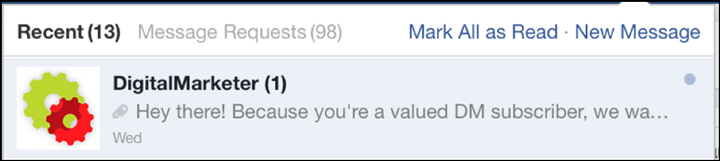
Image Source

It looks like any other message you’d get.

Plus, you don’t have to ask them to message you.

You can deliver a specific message without them needing to accept or initiate a call to action.

Since these users are already brand-aware, it’s best to message them with an offer or a discount now.

They know your brand, and you’ve likely qualified them up-front from your destination ads.

So you can push them further down the funnel.

DigitalMarketer has started using a coupon/discount-based tactic to convert these brand-aware users:

Image Source

Jon Loomer has taken a similar approach, attempting to drive qualified, brand-aware users to his training program:
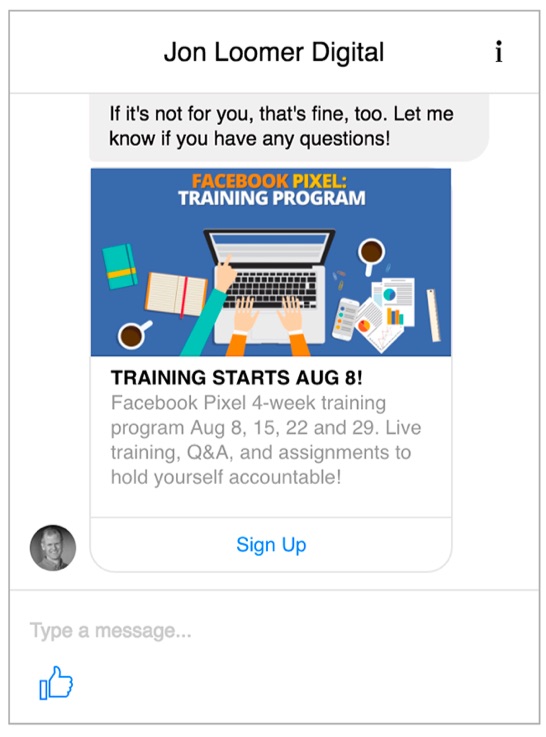
Image Source

Sponsored messages are akin to lead magnets or purchase offers in traditional advertising.

You’ve already done the majority of the work:

  1. Finding the audience
  2. Generating brand awareness
  3. Evaluating their pain points
  4. Qualifying users

Now you just need to complete the last step:

5. Getting them to convert on an offer.

This should be your final step in customer acquisition with Messenger ads.

It should help you get their detailed information as a qualified lead. Then you can nurture them via other platforms like email or phone.

To set up this audience, you’ll need to create a new custom audience based on engagement:
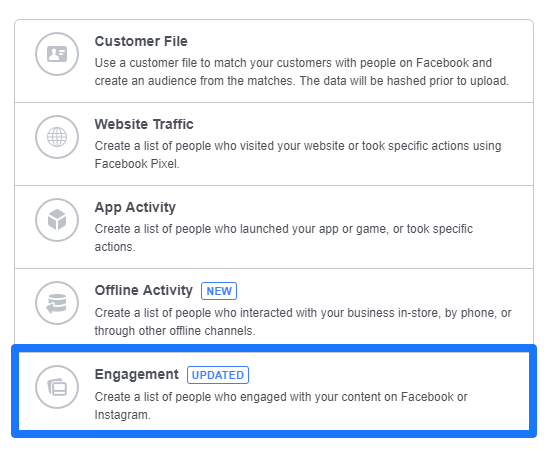
Next, select the “Facebook Page” option:
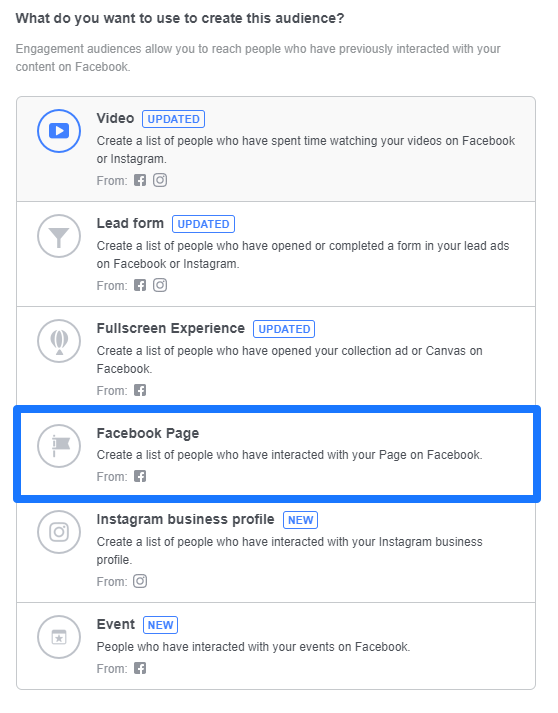
Now, select “People who sent a message to your page” as the custom audience criteria:

This will allow you to create sponsored messages.

Now all you have to do is create another ad with the message-based custom audience you created, and you’re ready to convert these brand-aware users into full-on customers.

Finding your needle in the haystack doesn’t have to be hard.

Try implementing each one of these ad types to work together to fill your customer funnel.

Conclusion

Facebook Messenger ads offer great, new ways to reach customers.

But with any new platform or technique comes risk.

What works? What doesn’t? How do you know without wasting thousands of dollars on testing?

Start by using Messenger destination ads to qualify prospects up-front.

These ads take a cue from account-based marketing, where qualification is done at the beginning of the user journey rather than at the end.

Once you’ve done this, you can place Messenger ads directly within the app and even send more personalized messages to engaged users with sponsored messaging.

You can use Messenger ads to do a lot more than you may have thought possible. You can use them to build up brand awareness at the beginning, nurture newly-aware leads, and convert them into qualified prospects who are ready to buy.

All at a fraction of the competition you’re typically running up against. Which means if you do it correctly, a fraction of the cost you’d typically spend, too.

About the Author: Brad Smith is the founder of Codeless, a B2B content creation company. Frequent contributor to Kissmetrics, Unbounce, WordStream, AdEspresso, Search Engine Journal, Autopilot, and more.


from The Kissmetrics Marketing Blog https://blog.kissmetrics.com/facebooks-new-messenger-ads/

4 Types of Social Media Content That Drives Engagement

It a big world out there. The amount of content being produced can be overwhelming. According to MarketingProfs, every single day over 2 million blogs are posted. Marketers are producing more content than ever before. With that much noise fighting for consumer attention, it only makes sense to invest in highly engaging, fun, and interactive content that will drive consumers to share it socially.

What types of content should marketers look to invest in order to drive social sharing?

Here are four types of social media content you can implement right now to drive engagement.

Interactive Content

Interactive content generates 4-5x more pageviews than static content, and social media is the perfect platform to showcase and explore interactive content. Here’s a look a few examples that have been proven to resonate particularly well with social audiences.

Quizzes

Quizzes can be used as a fun way for brands to engage customers. Marketers can use quizzes for brand awareness and a “fun” factor, or as a means to gauge customer interest in products. Results can be useful for recommending relevant subsequent content that drives back to the brand. With quizzes receiving 75% of their traffic from social media, it’s important to establish a promotion strategy to get the word out and generate buzz. A great way to encourage engagement, provide a score users can share on their social media channels.

Check out this fun quiz our partners over at SnapApp recently shared to help marketers determine which content to invest in for their holiday campaigns for a great quiz example.

Interactive Infographics

If you’re looking to share a large amount of data in a very visual way, interactive infographics are the way to go. There are endless ways to tell stories in infographics. Everything from embedded questions that pop up with answers, to maps that tell a story based on geographic location. We’ve been playing (yes, we have so much fun developing these it’s like playing) with animated gifographics. They catch the eye with subtle movement and provide snackable bits of data and analysis. How can you ensure you’re getting the most out of your asset while promoting across your social channels? While we’re developing gifographics in particular, we break each section out into separate gifs allowing us to share different data points over several weeks.

This great example from Quicksprout on How Google Works utilizes many of the best aspects of interactive infographics.

Survey/Poll

Soliciting real-time feedback is a great way to help you better understand your customers and what they care about. We’ve been incorporating polls on Twitter and our Instagram Stories and getting fantastic engagement.  We’ll often ask questions about a blog topic or campaign and then direct back to a content asset that provides additional information on the topic. Instagram Polls are a fun way to highlight giveaways or offerings at events. A great way to get the most out of your polls? Embed them on your website. You can embed Twitter Polls into blogs or web pages exactly like normal tweets, which means they will include a clickable “Follow” button. Win/win!

Here’s an example of a poll our friends at Hootsuite recently posted.

Live Streaming

Video, and in particular live streaming, has finally found its legs this year. Social video generates 1200% more shares than text and images combined. I’ve seen my streams get more and more inundated with cell phone conversations in airports, thought of the day posts, and general how-tos/tips and tricks updates. How can brands tap into these trends and still maintain a professional tone? The key is understanding why video resonates. It’s personal, authentic, and organic. Putting a human face behind the brand logo allows people to connect in a way they haven’t previously been able to. We’ve had fantastic results live streaming interviews with keynote speakers at events, sharing an inside peek into our company, and hosting general Q&A sessions. Live streaming is a fantastic way for you to share with your audience how you’re finding success and where you’ve failed. With more than 87% of online marketers currently implementing video content into their social strategies, if you’re not, you’re going to get left behind.

Memes

Who can resist a great meme? Memes allow you to tap into real-time cultural references that provide a quick laugh. With the average person now spending over 100 minutes per day on social media channels, they’re often looking for humorous content to pass the time. Memes provide a great way to show your brand has a human side and isn’t afraid to have a little fun. A simple way to get started, look at creating a few memes that poke fun at your day to day pain points. Here’s an example of a few we created for an April Fool’s campaign last year:

Bryan Mills April Fools

Derek Zoolander April Fools Meme

For marketers looking to stay on top of trends, it’s important to keep a pulse on what’s new in pop culture. These memes, while still funny, are less relevant today than they were in 2016 due to movie release dates. Relevant this month would be Stranger Things, Thor, or Taylor Swift memes that rift on what’s top of mind now. The challenge for marketers is to strike while the iron’s hot and master the balance between humor and relevance.

Motivational Quotes

Who doesn’t want a little pick me up throughout the day? When I’m scrolling through my social feeds, I always appreciate a good quote. Sure they can be overdone. Yes, there are (eh, hum) several memes out there poking fun at motivational quotes. But the truth is: people want to feel good. They enjoy getting the “feels” once in a while. Here’s where brands can really hit it out of the park. Don’t always use quotes relevant to your field. For example, there’s a ton of marketing quotes from amazing people like Steve Jobs and Seth Godin I could pull from, but I often step out of typical brand relevant messaging and go for something a little different. The rule I like to use: If a quote makes me think and gives me a smile, others might find it enjoyable as well.

Want to really drive the message home? Overlay your quote on a relevant image that really speaks to the message you’re relaying. Here’s an example of a recent #MondayMotivation we’ve had extremely high engagement with:

Vince Lombardi Motivational Quotes

There’s a common thread woven throughout all of these recommendations—people are looking for visual, lighthearted easy to process content they can easily relate to and share quickly. Not to say long-form content doesn’t have its place, indeed it does. However, to gain the attention and get people into that long-form content, you may want to explore creating some of the recommendations above to grab their attention to ultimately guide them back to your asset where they’ll find more education and value.

What types of content have you had success with to drive engagement for your business? What have you introduced to keep up with/beat your competitors in the last year? I’d love to hear about your experiences in the comments.

The post 4 Types of Social Media Content That Drives Engagement appeared first on Marketo Marketing Blog - Best Practices and Thought Leadership.


from Marketo Marketing Blog https://blog.marketo.com/2017/12/4-types-social-media-content-drives-engagement.html

FAQ This! Why Should I Care About Amazon AI?

The past three months, it seems, have been a nonstop parade of major tech events and the new product announcements that come with them.

One of the latest was last week's AWS re:Invent, where Amazon announced a new suite of AI-enabled technology designed with businesses in mind.

And while these new products, features, and tools come with a host of opportunities for the developers, marketers, and others who plan to use them, they also raise a few questions. What are they designed to do? How can they help you? How do they work?

There's also one less-official question that occurred to me as I learned of these developments. Is Amazon trying to creep into Google's territory?

Let's take a look at some of these AI announcements from AWS re:Invent and dig deeper into just what they mean.

1. What Is AWS Re:INVENT?

AWS re:Invent is what Amazon describes as "a learning conference" produced by Amazon Web Services -- that's what AWS stands for. The intended audience is what it calls the "the global cloud computing community," but the event features content for anyone who wants to learn how cloud technology can help grow and scale a business. From AdTech, to content delivery, to the internet of things, the conference ranges in learning opportunities from keynotes to certification sessions.

2. What Were the Major AI Capabilities Announced at AWS Re:INVENT 2017?

While a handful of new capabilities were unveiled by AWS, there are four that I'd like to focus on (with a bit of teaser text below on what each one is capable of doing):

  1. Comprehend: text analysis for a variety of content formats
  2. DeepLens: a wireless, artificially intelligent video camera with newly enhanced object recognition
  3. Transcribe: speech recognition technology to convert the spoken word to text
  4. Translate: what it sounds like -- advanced text translation technology 

If some of these sound familiar -- or seem reminiscent of similar capabilities previously made somewhat famous by a certain search engine giant -- chances are, it's because they are familiar. I'll delve deeper into this below, but many of these capabilities reflect those for which Google has been known to be a leader, especially in the realm of translation. After all, who could forget this jaunty promotional video on the topic?


3. What is What Is Deep Learning vs. Machine Learning?

The reason why I want to establish the difference between these two technologies (and what they are, in the first place) is that most of these capabilities use one or both. 

Machine learning essentially describes the ability of a machine to learn things -- habits, language, behaviors, and patterns, to name a few -- without having been programmed to do so, or pre-loaded with that knowledge. It doesn't describe artificial intelligence in entirety, but rather, is one very important AI capability.

Deep learning is a type of machine learning -- and is a bit trickier to explain. Basically, it takes the next (big) step in that it's designed to imitate the way the human brain works by way of something called neural networks. In our brains, we have biological neural networks in which the action of one neuron creates a series of subsequent actions that ultimately result in our different behaviors.

In technology, artificial neural networks seek to replicate that phenomenon by becoming "trained" to comprehend data based on a certain set of criteria. One of the more notable examples of deep learning in practice is in image recognition, in which neural networks are able to recognize different data patterns or cues to learn what, for example, a cat looks like.

4. What Is Amazon Comprehend?

Amazon Comprehend uses something called natural language processing (NLP) to better understand and determine the meaning within text. It's an instance of machine learning, in which the technology learns how to comprehend -- if you will -- and process language as it was intended by the human being speaking or writing it.

Comprehend performs this capability with a series of steps:

  1. Identify the language.
  2. Pick out the phrases that most strongly indicate what the text is about -- things like names of people, companies, places, or important events.
  3. Use those phrases to determine if the sentiment of the text is positive or negative.
  4. File that set of text according to its topic within a collection of subjects it has already organized based on patterns it's observed.

So, how does this technology apply to the real world? Well, it's particularly helpful in an instance of, say, analyzing written customer feedback. By feeding these comments to an API like Comprehend, marketers can use this technology to synthesize data from their audiences to determine something like thematic areas of improvement.

5. What Is DeepLens?

Simply put, DeepLens is a high definition video camera that was designed with developers in mind. It was built with deep learning capabilities and what AWS Chief Evangelist Jeff Barr describes as "pre-trained models for image detection and recognition."

In other words, it's a very smart camera: one that can recognize objects, faces, motions, and creatures (e.g., a dog from a cat). And while that's very cool -- not to mention, somewhat reminiscent of the recently-announced Google Clips camera -- there's a reason why it could prove so helpful to businesses.

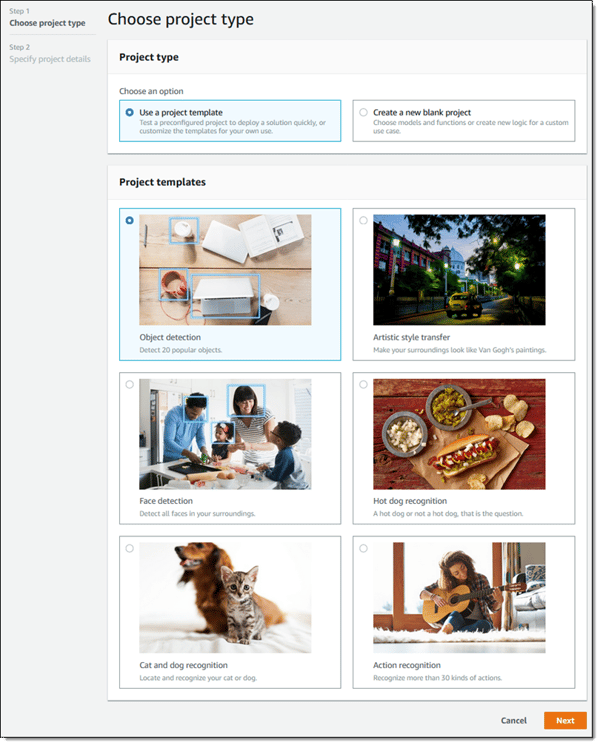
To start, DeepLens comes with a number of "templates," or recognition technologies that users can build upon for their own projects. Object and action recognition, for example, can help to more seamlessly create something like product tutorials or demonstrations, by developing a system or algorithm that learns to recognize how the two are paired for different outcomes.

For example, if you're demonstrating how a certain cooking appliance can be applied to different scenarios, it seems that DeepLens can be utilized in building a system to recognize the appliance itself (like a standing mixer), the actions the user can take with it (like mixing cake batter), and the resulting outcome (a delicious cake).

Source: Amazon Web Services


6. What Is Amazon Transcribe?

Anyone with a journalism background is more than familiar with the headache joy of transcribing spoken interviews. We want to get it just right, be sure not to misquote the interviewee, and communicate what was said in the right context.

If only, back in my earliest days of reporting, there were advanced transcription services available to the common writer.

But now, there's Transcribe: an AWS service that uses machine learning technologies to recognize the spoken word and transcribe it into text.

While the function itself is fairly intuitive, the benefits might not be. So let's lay out two instances where technology like this can be applied to a marketer's world:

  1. Interview transcription. I already covered this a few paragraphs earlier, but let's say you're writing up a blog post that requires quotes from a spoken interview. This technology eliminates the time-consuming step of transcribing what was said, and leaves you instead with all of the text from that conversation, allowing you to pick and choose the quotes you want to incorporate.
  2. Video transcription. Accessibility is no longer optional. It's important to provide a way for individuals who are hearing impaired to be able to consume and enjoy your video content, even without the audio. Transcribing what is said in the video by way of full paragraphs or subtitles allows them to do so -- and, it allows those who simply prefer to watch videos without sound to be able to absorb the content, as well.

These are only two of the more prominent examples of how such technology could be applied, but there are many more, from transcribing podcasts, to documenting notes from an important meeting.

7. What Is Amazon Translate?

This development might be my favorite.

Around here, we talk a great deal about approaching marketing with a global mindset. While I might use JetBlue as a remarkable example of marketing, it might not resonate as much with audiences in countries where this airline doesn't operate.

To put it simply, the internet is a global, international destination. The people reading your content might not regularly engage with the same brands you do, and they might not speak the same language.

That's why a growing number of developers and marketers are building a multilingual web presence -- one where their online properties and content can be seamlessly viewed in the language preferred by the user. It's a trend that, as HubSpot's own global presence continues to grow, I take inordinate glee in seeing.

It's also why I love seeing tools become available that make it easier to approach marketing with a "global first" mindset. Translate is one such tool: a service that uses machine learning to more naturally translate text from one language to another. 

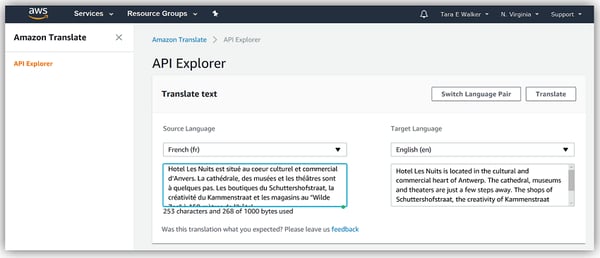
Here's a look at how it worked when translating a French paragraph to English:

Source: Amazon Web Services

So, here's the million-dollar question: Is Amazon creeping into Google's territory?

Maybe.

It's not the definitive answer I hoped to have, but in these early release days, it might be too soon to tell. While most of Google's headline-making AI developments are largely consumer-centric (like the previous example of Clips), it is true that the company has been working on its own stack of machine learning capabilities for businesses. Look no further than Google.ai, for example, where the mission is to bring "the benefits of AI to everyone" -- including, I assume, marketers.

This is only the beginning.

What are you most excited about? What confuses or scares you, and what fills you with delight? Feel free to weigh in with your thoughts on these AWS AI developments on Twitter, or let me know if you have a question about it.


from Marketing https://blog.hubspot.com/marketing/amazon-web-services-ai

Monday, 4 December 2017

SEO Cheat Sheet: Best Practices for On-Page Optimization

Anything worth doing is worth doing well, and that’s certainly the case when it comes your website’s Search Engine Optimization. It’s safe to say that SEO best practices are a moving target with Google’s dedication to innovation and a constant stream of updates since inception. To hit that target, you need a content marketing plan and a good engagement platform. There are two main components of an SEO strategy, on-page, and off-page.

This cheat sheet will focus on on-page optimization and pointers to help you stay on top with less effort and more continuous, measurable results.

The Key to Keywords

Keywords are a large part of a solid on-page SEO strategy: they make the content your audience already loves appear equally enticing to search algorithms. But if your CEO asked you about it in the elevator, could you confidently explain your keyword strategy? Do you know which keywords you should be ranking for in the first place?

Nailing down a precise, targeted list of keywords is the very first step to conquering SEO. To begin, brainstorm a list of keywords you would like to rank highly for.

There are four ways to do this:

  1. Manually cull keywords from your existing sales and marketing materials, your current content, and the words you use to describe your products and services.
  2. Type those manually generated keywords into Google, scroll to the bottom of the results page, and see what other, related search terms Google is recommending.
  3. Generate a list of high-performing keywords from your marketing automation software.
  4. If you have a physical location, add the names of a few local cities to your top keywords for highly targeted variations.

Whether you use one of the above techniques or combine them, you’ll end up with a very long list—it could be hundreds of words long. Now it’s time to be ruthless and edit it down. Hone in on the keywords most likely to drive the right type of traffic to your content in the highest numbers—maybe 150, max.

Trim the Fat:

  1. Use critical thinking to banish tangential keywords. Remove any words that aren’t really related to what you sell, or that your ideal customers are unlikely to search for. EXAMPLE: You sell sweaters for cats that you make by hand. An example of an irrelevant keyword phrase: “make cat sweater.” Yes, you make your own cat sweaters, but the person searching is probably looking for instructions, not for sweaters.
  2. Sort your keywords by volume and degree of competition. A keyword might be a popular and relevant search term, but if everyone is using it, it’ll get diluted—which means you’ll have a hard time ranking highly for it. Conversely, if a keyword doesn’t have a lot of competition, but no one ever searches for it, there’s no point using it. The Holy Grail is the keyword that ranks high in search volume but isn’t too competitive
  3. Weed out branded terms. If one of your keywords is the brand name of a competitor, you might not want to bother targeting it. If most of the first-page results for “denver cat sweaters” are pages on the Denver Cat Sweaters website, blog reviews of the latest style, etc., you’re probably not going to break in—even if you’re making the best cat sweaters in Colorado. And if you did, it probably wouldn’t matter, because users are most likely looking for the brand anyway.

Black Cat in White Cable Knit Sweater

To end up on your list, each keyword must be:

  • Extremely relevant to your business
  • Frequently searched for
  • Not branded by your competitors
  • Powerful enough to convert someone into a lead

The Missing Keyword Ingredient: User Intent

Keywords used to be enough for a savvy SEO/content marketing strategy, but not anymore. Spammy SEO strategies exploited search engines’ fondness for keywords, and search engines fought back. There are now dozens of algorithms, machine learning programs, and artificial intelligence bots working around the clock to deliver the content that users actually want. That means you also need to understand the intent behind the keywords that your audience is using.

EXAMPLE: When a user searches for “homemade cat sweaters,” does she want to buy one, or does she want a pattern to make her own? If someone Googles “marketing automation,” does he want to buy software or learn what the term means? That’s user intent. The good news is, Google is hard at work trying to answer that same question, and they can’t keep their findings a secret. Like so many things in life, all you have to do is Google it.

Search your top keyword and scan the Page 1 results. Are they product/sales pages, or are they informational resources? Google has tracked countless clicks and engagement metrics to determine what users want for that keyword, and these 10 results represent what they’ve found.

If your results are mostly sales pages such as different brands of cat sweaters, then most people who search “homemade cat sweaters” want to buy. If the results are mostly patterns to make your own, then that’s what users want. If there’s a pretty even mixture of both, then you have your work cut out for you.

Colorful Sweater on Myrtle the Cat

Build Your Content Kingdom

Armed with the right keywords and the user intent behind them, it’s time to start creating content that will proactively improve your on- page search rankings. This won’t happen overnight. But with a solid list of keywords and an understanding of how to use them, your rankings will soon climb.

Step 1: Create personas so that you know exactly who you’re trying to attract with your keywords.

Step 2: Segment your keywords into categories aligned with those personas.

Step 3: Compare the content on your site with the keyword/user intent/persona combos you’ve developed. Identify where you already have content that meets the users’ needs, and where there are gaps.

Step 4: Create a prioritized list of content that needs to be (A) updated to make better use of keywords and other on-page SEO strategies, or (B) created to fill in a gap.

While keywords are key (ha) for making your content compelling to search engine algorithms, it’s more important that real live humans find your content relevant. Even if your keywords attract a lot of visitors, Google’s algorithm will notice if those visitors quickly bounce from your site and will lower your ranking accordingly. So rather than “stuffing” your content full of keywords, create content that actually addresses the intent of keyword searchers.

Tips for On-Page Optimization:

  • Optimize each page for one keyword/user intent combination, using normal, human language. Use variations of the phrase naturally within your page.
  • Use keywords in your URLs, with hyphens between the words to make them easier to read:
    https://www.clothing-for-pets.com/cat-sweaters.
  • Use keywords in your image file names and alt tags, as appropriate. It’s okay to title the picture of a cat in an orange sweater, “cat-sweater-orange.jpg,” but it’s not okay to use irrelevant titles/tags. If the picture is a cat sitting in an armchair wearing an orange sweater, the text can say, “cat in an orange sweater sitting in an armchair,” but not, “orange cat sweaters.” Google hates keyword stuffing and you won’t get away with it.
  • Use keywords in your headers and style them with <h1>,<h2>, and <h3> tags.
    • Your blog post about the latest cat sweater style, for instance, might have a header with HTML like this: <h1>The Latest in Feline Fashion: Cable Knit Sweaters<h1> 
    • Followed by subheads at frequent intervals that say things like: <h2>Does the idea of your feline friend looking like a dapper gentleman strike your fancy?<h2> But again, use them naturally. Search engines are getting better at recognizing keyword stuffing every day. Write for the reader.
  • Create keyword-rich categories for your blog posts.
  • Use keywords naturally throughout your actual body text. There is no magic ratio or keyword density. Write content your user will enjoy and search engines will favor it as they do.

Next Steps

Capturing metrics on how your keywords are performing will help you fine tune your on-page optimization strategy over time. Many engagement platforms allow you to access metrics such as visits, leads, and rank right within your platform. This way, you’ll attract the audience you want, for the right reasons.

Of course, all the great keywords in the world are no match for well-done content. But if you can create great content based on strategic keyword/user intent combinations, you’ll be creating SEO-savvy content that your audience actually wants—and that is how SEO drives real results.

How has your SEO strategy changed over the years? What other best practices do you employ for SEO? Tell me about your strategies in the comments.

The post SEO Cheat Sheet: Best Practices for On-Page Optimization appeared first on Marketo Marketing Blog - Best Practices and Thought Leadership.


from Marketo Marketing Blog https://blog.marketo.com/2017/12/seo-cheat-sheet-best-practices-page-optimization.html

5 VR Marketing Examples That You'll Want to Steal for 2018

The holidays are coming, and I'm feeling cheerful.

So, I'll do you a solid: I won't lecture you on the importance of incorporating virtual reality into your 2018 marketing strategy.

But, in the spirit of giving, I will share the following fun facts:

  • By 2020, the economic impact of virtual and augmented reality is predicted to reach $29.5 billion.
  • By the end of 2017, the combined total of VR software and hardware from Sony, Oculus, HTC, and others is predicted to reach 5.1 million units. That's over a 75% increase from 2016. 
  • By 2020, the number of VR headsets sold is predicted to reach 82 million -- a 1507% increase from 2017 predicted totals.

In other words: Yeah, VR marketing is a thing you need to think about.

And if you're seeking inspiration, look no further. Here are five of our favorite VR marketing campaigns. 

1. Key Technology: VERYX Food Sorting

Key Technology, a manufacturer and designer of food processing systems, created a Virtual Reality demo that would allow attendees of the Pack Expo food packaging trade show to experience a detailed, hands-on look at how the company's VERYX digital food sorting platform works. It was part of a comprehensive B2B campaign to grow brand awareness among a target audience of food manufacturers, and VR gave participants a highly unique look at what exactly the process looks like inside of the machine.

While this 360° video doesn't completely replicate the experience, it does indicate the differentiating way brands within such B2B industries as manufacturing can leverage VR to immersively demonstrate their sophisticated technologies and capabilities.

2. Defy Ventures and Within: Step To The Line

When I attended Oculus Connect in October, the most memorable experience for me was, by far, the event's VR For Good exhibit: a showcase of creative work that used Oculus and VR technology for social- and mission-focused ventures.

One such example of that work was Step To The Line: A short film (that was immersively viewed on a VR headset) documenting the lives of inmates at California maximum-security prisons. It was created by Within, a VR storytelling production company, in partnership with Defy Ventures, an entrepreneurship and development program for men, women, and youth who are currently or were formerly incarcerated.

With this unique watching experience, viewers were able to uniquely see what life is like within the walls of these correctional facilities, from the yard, to the cells, to the conversations that take place there.

3. Limbic Life: Project VITALICS

For far too many people, injuries, age, and disease can diminish mobility and equilibrium to the point where walking ranges from extremely painful to nearly impossible.

That's why the folks at Limbic Life created the Limbic Chair, in partnership with the VITALICS research being conducted by RehaClinic. Pairing this special chair with a Gear VR headset allows users to more intuitively move their bodies (thanks to the chair's combined neuroscience-based and ergonomic design) while virtually experiencing day-to-day experiences with a rehabilitative use of their hands and legs.

While the research is still underway and no definitive conclusions have been drawn, I had the opportunity to use the chair at the 2017 Samsung Developer Conference and speak with the chair's creator, Dr. Patrik Künzler.

"Patients enjoy being in the chair and the freedom of movement it allows. They enjoy VR a lot, especially the flying games," he told Samsung Business Insights. And not only can the VR technology help them physically heal, but it also contributes to emotional rehabilitation.

"When they get up from the chair," Künzler said, "they’re in a good mood and feel happy.”

Learn more about the conceptualization behind the Limbic Chair from Künzler's TEDxZurich talk below.

4. Lowes: Holoroom How To

Anyone who's gone through the existential angst of being a first-time buyer knows the unfathomable power of paperwork and finances to undermine the fun of designing or decorating a new home.

That is, until you walk into one of 19 Lowes stores that features the Holoroom How To VR experience.

If you're lucky enough to have any money leftover to pay a professional to renovate your home, well, good for you. But for the rest of us, the next stop is the world of do-it-yourself (DIY) home improvement, which comes with its own hefty dose of stress.

That's why Lowes decided to step in and help out homeowners -- or recreational DIY enthusiasts -- with a virtual skills-training clinic that uses HTC Vive headsets that guides participants through a visual, educational experience on the how-to of home improvement.

5. Boursin: The Sensorium

I'll be honest. I recently pledged to give up dairy -- okay, 48 hours ago -- and I already miss cheese, a lot. 

You can imagine my glee, then, when I discovered that cheese brand Boursin once created a VR experience to take users on a multi-sensory journey through a refrigerator to shed light on its products' flavor profiles, food pairings, and recipe ideas.

The goal: to raise awareness among U.K. consumers of Boursin's distinct taste and product selection.

While the VR installment was part of a live experiential marketing campaign, the rest of us can get a taste -- pun intended -- of the virtual experience via this YouTube video.


from Marketing https://blog.hubspot.com/marketing/vr-marketing-examples

Friday, 1 December 2017

3 Reasons Why Marketing Automation Is No Longer Optional for the Banking Industry

Marketing automation is no longer just an industry buzzword. In fact, 91% of marketing automation users agree it is very important to the overall success of their online marketing activities.

Historically, the fastest industry adopters of marketing automation include software, internet, telecommunications, and business services. However, dramatic strides in digital advancement have shifted the world of retail banking like never before. With this, a change in consumer behavior and expectations have triggered banks to respond by redefining their traditional mindset of marketing.

In this blog, I will share the three main challenges the banking industry faces when engaging today’s modern consumer and how marketing automation is the key to overcome these challenges.

Seek Out Opportunities in Data

Most industries are far ahead of financial services with insight-driven marketing. This is surprising since banks and credit unions have access to significantly more transactional, behavioral, and demographic consumer data that would make other industries drool with envy. In fact, a 2017 Accenture study found that 73% of US consumers are willing to provide their banks access to personal and financial data in return for added benefits in the form of offers, reduced interest rates, recognition and custom financial advice.

However, despite ever-increasing volumes of rich data, most financial institutions struggle to ever profit from it. In fact, banks and credit unions only use a fraction of their collected data to generate consumer insights and enhance the customer journey. Research reveals that less than 50% of banks analyze customers’ external data, such as social media activities and online behavior and only 29% analyze consumers’ share of wallet—the key measure of a bank’s relationship with its consumer!

Hurdles_financial_services_firms_experience_when_trying_to_realize_be-nefits_of_big_data-565x446 2What does this mean for the banking industry?

According to research by Narrative Science, the single biggest barrier to big data success among financial services firms is the existence of data silos followed by the lack of time and recourses needed to analyze and derive insights from data. With marketing automation, banks can now realize the promise of big data by obtaining a 360-view of their customer in real time. This allows them to capture and manage data from a vast array of sources and marry consumer insight with marketing strategy in order to enhance customer engagements and identify new upsell and cross-sell opportunities.

Use of Data to Define the Customer Journey

As the importance of leveraging big data in the banking industry rises and it becomes collectively agreed that consumer insight is an important differentiator against competition—there still seems to be a long way to go.

Unless consumer data can be used to understand the customer, look out for the customer, or reward the customer, the data insight is of limited value. Fortunately, with marketing automation, it now possible for banks and credit unions to use data to develop actionable insights and provide engagements that are relevant to the customer’s stage of life and immediate financial needs.

Facebook Example

So, what does the intersection of consumer data and marketing strategy look like?

Scenario #1: Tyler Clark is a college student looking for student financial assistance and lives in Texas. He googles “student loans Austin Texas”, visits United Heritage Bank and is presented with a banner ad for college financing.

Scenario #2: After graduation, Tyler gets his first job and is in the market for a house. He visits his credit union’s website to read about their home loan offers but decided to hold off. Later while on Facebook, he is targeted with an ad from his bank offering a special home loan offer.

Scenario #3: Tyler is growing up and going through many stages of life. Time is becoming more precious. He receives a direct mail piece from his credit union offering investment options and assistance in opening a retirement account.

What does this mean for the banking industry?

The traditional marketing funnel is dead which means that it’s becoming increasingly important for banks and credit unions to develop awareness of the customer journey in order to know where and when to market to customers when something triggers the need for financial services.

Unfortunately, research indicates that only 37% of customers believe that their banks truly understand their needs and preferences. This being said, many predict an immense rise of AI-based technologies that will provide the banking industry with the ability to automate and analyze immense amounts of data and apply it to the customer journey at record speed.

Embrace Emerging Channels

Digital banking has come a long way since it was first introduced in the 1980’s. Then, you needed a landline to access account balances. Today, the ability to transfer funds, make payments, and deposit checks is at your fingertips. As technology continues to advance, so will consumer behaviors and expectations, challenging banking providers to rethink their strategy and transform the customer experience.

The migration away from brick and mortar banking began years ago and will surely escalate in 2018 as digital engagement becomes easier and consumers place a greater premium on their personal time. A Forrester study shows that in just a 5-years, omni-digital behavior (digital only) grew from 27% to 46% and they also predict that most financial institutes will not even see half of their customers, members or clients in 2018 due to digital advancements.

The_rise_of_the_omni_digital_banking_consumer-565x435 2

What does this mean for the banking industry?

Creating a connected customer journey across all channels is now vital to engaging and retaining consumers. However, most banks find it challenging to create a  single view of the customer which is compounded by the noise coming from multiple channels. In fact, a study shows that only 20% of consumers feel the services they receive is of the same quality across all the communication channels they use with their financial providers and most marketers admit that about half of their campaign messages are identical broadcasts from one channel to the next. There is a distinct difference between casting the widest net over multiple channels with the same message versus creating an inter-related experience across channels to engage with consumers on a holistic level. Marketing automation allows banks to connect and associate multi-channel communications to each other for the purpose of creating an integrated experience.

Bottom Line

Shifting consumer behavior and expectations will continue to evolve at an exponential level. With this, so will the challenges being faced by the banking industry, forcing many to rethink strategy and transform the consumer experience—in an exciting way! Marketing automation software will be the driver that enables the banking industry to propel their use of rich consumer data in order to seek out new opportunities and redefine the meaning of a cross-channel consumer relationship. Marketing automation technology is no longer a nice-to-have for the modern marketer—now it’s a must-have. And, financial institutions are no exception.

Are you a bank or credit union who has seen success using marketing automation? What improvements have you seen recently? Or, are you a consumer and have seen the downside of impersonal communications or the benefit of personal ones from your financial institution? I’d love to hear about your experiences in the comments below.

The post 3 Reasons Why Marketing Automation Is No Longer Optional for the Banking Industry appeared first on Marketo Marketing Blog - Best Practices and Thought Leadership.


from Marketo Marketing Blog https://blog.marketo.com/2017/12/3-reasons-marketing-automation-no-longer-optional-banking-industry.html

How to Reclaim an Unproductive Day in 6 Steps

Click. Click. Click.

Tick-tock. Tick-tock. Tick-tock.

That's the sound of an unproductive day passing by. It's the sound of any day, Monday through Friday, going to waste -- where despite your best intentions, you just can't seem to get moving, or get stuff done.

It happens to all of us. Seriously.

But what's an otherwise industrious person to do when these days unexpectedly fall upon us? We've got some ideas -- six of 'em, in fact.

1) Remember what's in store when you're done with your tasks.

Truth time: Sometimes, I bribe myself.

I know how silly it sounds, but it's true. If there's a task that I've been putting off, but there's also something else I've been looking forward to doing, I'll bribe myself with the latter to get the former done.

Case in point: I had a rather big piece of writing to complete over the summer, and as the clock was running out on my deadline, I was having trouble getting started. At the same time, my best friend and I were heading to Las Vegas in a few weeks, and I was really looking forward to planning the trip.

"Okay, self," I thought. "You get a draft done today, and tonight, you can start planning your Vegas trip."

It doesn't even have to be something that's a big deal, like planning a vacation. My colleague, HubSpot Senior Growth Marketing Manager Niti Shah, once told me that she pays herself in cookies and mozzarella sticks for completed tasks.

The point is, it's okay to reward yourself for progress. Just make sure the reward matches the work completed, and that you're not treating yourself to a week in Hawaii for sending an email.

2) Take a break.

This one is an oldy-but-goody. According to data collected by DeskTime, the top 10% most productive employees take 17-minute breaks for every 52 minutes of work they put in. And during those periods, they use hyperfocus: No work during breaks (that includes email), and no distractions during the work time.

I often liken this tip to boxing training. When I used to box, I had a trainer who would have me throw non-stop punches for three-minute intervals, with one-minute breaks in between. If you haven't tried it, three minutes is a long time for that kind of exercise, which makes the one-minute rest period especially important for your heart rate and muscle recovery.

In my experience, the mind works in a similar way. An hour spent on a task or a project that requires deep thinking, creativity, or number-crunching is, to me, the equivalent of a three-minute, high-intensity boxing interval. You need the recovery period. So next time you feel like your brain just can't quite throw that left hook, take a minute, and let your "intellectual heart rate" return to normal.

3) Work on something completely unrelated to your to-do list.

When I was visiting my parents for Thanksgiving -- which happened to overlap with the writing of this blog post -- my mom asked me if I could help her troubleshoot an issue on her laptop.

It was the last thing I wanted, or thought I had time to do. It was a short week. I was taking a day off. I had a long list of things to do, and I was already taking longer to get through it than I had hoped. But it was my mom, after all, so of course, I helped.

By the time we were done figuring out the problem, for some reason, I felt reinvigorated. I had a new motivation to finish my tasks, and finish them quickly. Sure, I had taken a "break," in some sense -- but I had also redirected my brain to another task. My mind was still being put to use, but for something completely unrelated to my to-do list.

If you're feeling stuck, use your brain for something else. Maybe there's a colleague who you've been meaning to get back to on an unrelated project, or maybe you just need to do a quick online puzzle. Keeping your mind active while giving it a break from the dredge of your to-do list might leave you feeling re-energized and ready to hit the ground running, wherever you left off.

4) Deny the "delete" key.

Writer's block, amirite?

If you work in marketing, there's a chance that, at some point, your job requires you to write something. And we know -- that's not easy, even when you do it every day. And much of the time, it's getting the words down that's the hardest part, whether it's getting a composition started, or getting the sentences to sound right.

STOP. That second part, about getting it to sound right? Forget it.

For way too many of us, our perfectionism is a pitfall to productivity. We write, stop, delete, re-write, and repeat the process until 45 minutes have gone by and we've written one sentence.

"I'd even say to ignore the 'delete' key on your first draft," HubSpot Sales Blog Editor Aja Frost once advised. 

You heard it here: Deleting is not your friend. Just form a sentence -- any sentence relevant to your topic -- and keep going.

5) Make plans.

Remember what I said about bribing yourself? Well, sometimes, you might have to invent said bribe to get yourself motivated.

Here's another tale of writing something that I had been putting off. (I'm not a slacker -- I swear.) At about 4:00 PM one afternoon, I thought to myself, "I really, really need to get this done before I leave." So, I texted a friend and asked if she wanted to meet for happy hour at 6:00.

Boom. Instant deadline.

The thing is, it was a self-imposed deadline -- one that was established by plans to do something fun. If I had just set a timer for two hours, for example, it may not have been as effective. But because cutoff time was motivated by something recreational, I really wanted to get my task done.

A word of caution, however: Do not -- I repeat, do not rush through your work and turn in something with poor quality just for the sake of getting it done. Once your task is complete, let it marinate overnight, then come back to it with a new perspective the next day.

6) Do the thing you dread the most -- even if it's the only thing you accomplish today.

We've all had that long list of tasks that contains one, glaring item that seems like moving a boulder up a hill. Except, you dread facing that boulder so much that it causes a bit of "productivity paralysis," and in the process of putting off that one item, you end up putting off everything else on the list, too.

What? Am I the only one who's wasted an entire morning looking at real estate listings instead of addressing what I needed to get done?

That's when you need to face the boulder, because it's still going to be there, no matter how many homes you fantasize about buying. And once that one, dreaded task is complete, the rest of the items on your list probably pale in comparison -- and you might be so energized by getting the biggest one done, that since you're already on a roll, you feel newly motivated to get everything else done.


from Marketing https://blog.hubspot.com/marketing/reclaim-an-unproductive-day